


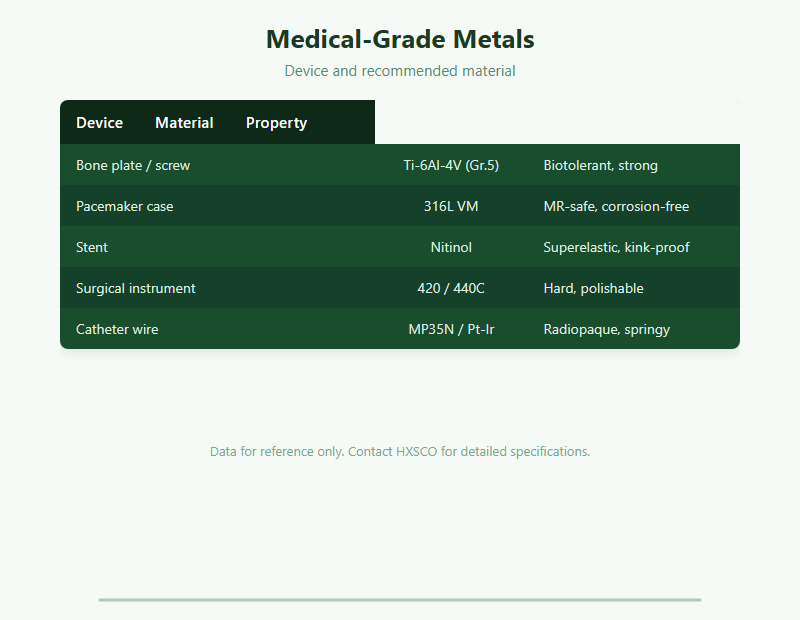
Short answer: Medical devices use a short list of biocompatible metals: titanium Ti-6Al-4V for implants, 316L vacuum-melt stainless for instruments and cases, Nitinol for self-expanding stents, and specialty alloys for wire and radiopaque parts, all finished and certified to medical standards.
At a Glance
What Biocompatibility Demands
Implant metals must be chemically inert, corrosion-free in body fluids and free of toxic ions, so titanium and high-purity stainless lead. Our Titanium Grade 2 vs 5, Passivation Guide y Electropolishing Guide explain the surface requirements.
Titanium and Stainless
Ti-6Al-4V implants and 316L VM stainless instruments are the workhorses; grade and form are in our 316 vs 316L, Stainless Grades Explained y Titanium Sheet Supplier pages.
Specialty Alloys
Nitinol stents exploit superelasticity, cobalt-chrome resists wear, and radiopaque platinum alloys aid imaging; see our Shape-Memory Alloy Guide, Cobalt Alloy Supplier y Inconel Supplier.
Surface, Finish and Cleanliness
Medical parts need electropolished, passivated, particle-free surfaces; our Surface Treatment Guide y Degreasing Guide cover prep.
Sourcing Medical-Grade Stock
Buyers specify alloy, melt practice (e.g. vacuum melt) and ASTM or ISO standard, then require full mill certification. Our How to Choose a Metal Supplier y Mill Test Certificate Guide frame the RFQ.
Get a Quote
Tell HXSCO your requirements and we will respond with a competitive quote and lead time.
Preguntas frecuentes
Ti-6Al-4V (Grade 5) and commercially pure Grade 2 for biocompatibility.
Low carbon avoids sensitisation and it polishes and passivates cleanly.
Self-expanding stents and guidewires due to superelasticity.
Electropolished and passivated for a clean, corrosion-free surface.
We supply titanium, stainless and specialty alloys with mill certificate; confirm the standard.
Source Medical-Grade Metal from HXSCO
HXSCO supplies titanium, stainless and specialty alloys for medical devices with mill certificate. Send your specification for a quote.