


Short answer: Metal hardness is measured by an indenter and load: Rockwell is fast for production QC, Brinell suits cast and coarse-grain parts, and Vickers gives precise values for thin or small sections, with conversion tables linking the scales and records backing each shipment.
At a Glance
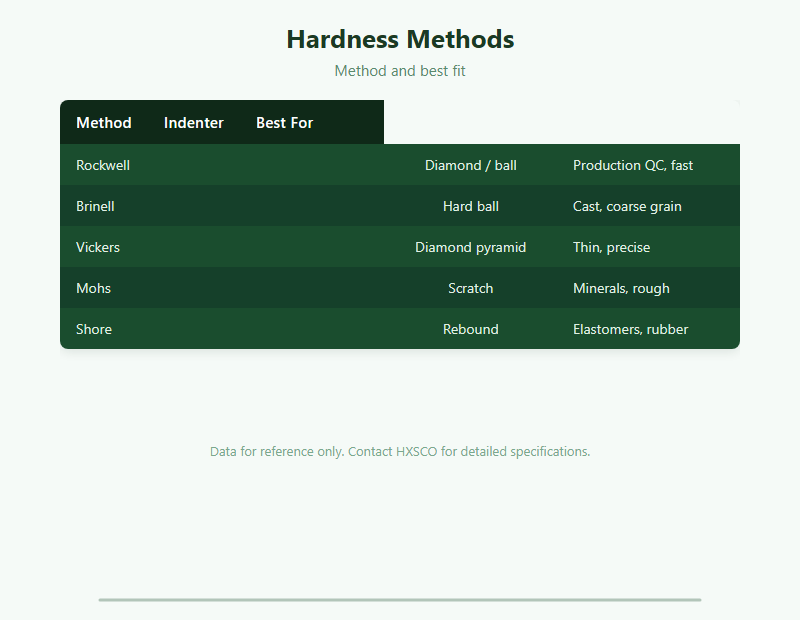
Methods and Indenters
Hardness reflects resistance to indentation and links to strength; the strength data is in our Vergleich der Stärken, the treatment that sets hardness in our Heat Treatment Guide and the grade families in our Types and Grades of Steel.
Rockwell in Practice
Rockwell uses a diamond or ball with quick readout for production lines; the tooling grades are in our Tool Steel Types Guide, the alloy base in our Nickel Alloy Supplier and certification in our Mill Test Certificate Guide.
Brinell and Vickers
Brinell covers cast and coarse parts, Vickers covers thin and precise sections; the casting comparison is in our Forging vs Casting page, corrosion care in our Corrosion Resistance Guide and the proof in our Mill Test Certificate Guide.
Conversion and Records
Scales convert through tables and the value is logged per lot; the dimensional limits are in our Tolerances Guide, fatigue limits in our Fatigue Guide and packing in our Export Packing Guide.
Get a Quote
Tell HXSCO your requirements and we will respond with a competitive quote and lead time.
Häufig gestellte Fragen
Rockwell — direct readout, ideal for production QC.
For castings and coarse-grain metals where a large indent is better.
Its small pyramid indent measures thin or small sections precisely.
Yes — conversion tables link Rockwell, Brinell and Vickers.
Hardness is reported on the mill test certificate where specified.
Verify Hardness with HXSCO
HXSCO supplies material with hardness tested and recorded to your specification. Send the grade and hardness range and we will quote.