


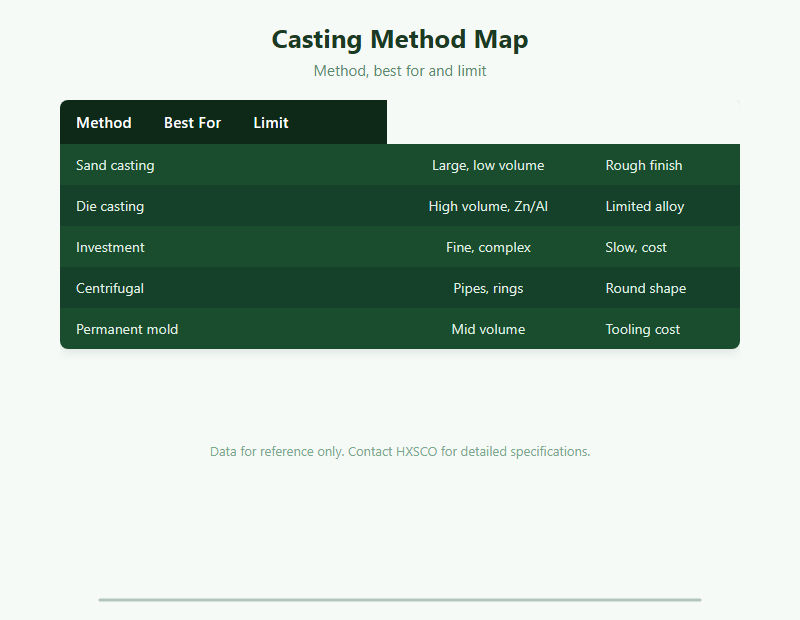
Short answer: Casting turns molten metal into a shape by pouring into a mold; sand casting suits large low-volume parts, die casting suits high-volume zinc and aluminum, investment casting suits fine complex parts, and centrifugal casting suits pipes and rings – chosen by tolerance, volume, alloy and cost.
At a Glance
The Four Main Processes
Sand, die, investment and centrifugal casting each trade tolerance, volume and cost differently, with the material base in our Carbon Steel Supplier und Aluminum Supplier pages and the alloy logic in our Nickel Alloy Grades Guide.
Tolerance and Finish
Investment and die casting hit tight tolerance and smooth finish; sand casting is rougher, with fit detail in our Tolerances and Fits Guide and surface in our Surface Treatment Guide.
Alloy and Cost
Die casting favours zinc and aluminum, sand and investment take almost any alloy, with cost logic in our Standards Comparison and density effect in our Density Comparison; finishing is in our Finishing Coating Guide.
Choosing and Sourcing
Buyers set volume, tolerance and alloy, then confirm with our Mill Test Certificate Guide and pack per our Export Packing Guide; related forming is in our Extrusion Process Guide.
Get a Quote
Tell HXSCO your requirements and we will respond with a competitive quote and lead time.
Häufig gestellte Fragen
Sand casting for low volume and large parts; die casting for very high volume.
Investment casting gives the finest detail and tightest tolerance.
No – steel is too hot; die casting suits zinc, aluminum and magnesium.
Pipes, rings and bushings where a dense round wall is needed.
By visual, dye penetrant and radiographic inspection plus chemistry certificate.
Source Cast Components with HXSCO
HXSCO supplies cast and machined metal parts in sand, die and investment processes with the alloy, tolerance and certificate your design needs. Send your drawing for a quote.