


Short answer: Casting defects — gas porosity from trapped air or moisture, shrinkage cavities from inadequate feeding, cold shuts from metal that met too cold to fuse, and sand or oxide inclusions from contaminated moulds or melt — are the main yield and quality risks in sand, permanent-mould and die casting. They are controlled by sound gating and risering, correct pour temperature and venting, clean melt practice and proper mould preparation, with critical parts verified by X-ray or other NDT and documented per the casting specification.
At a Glance
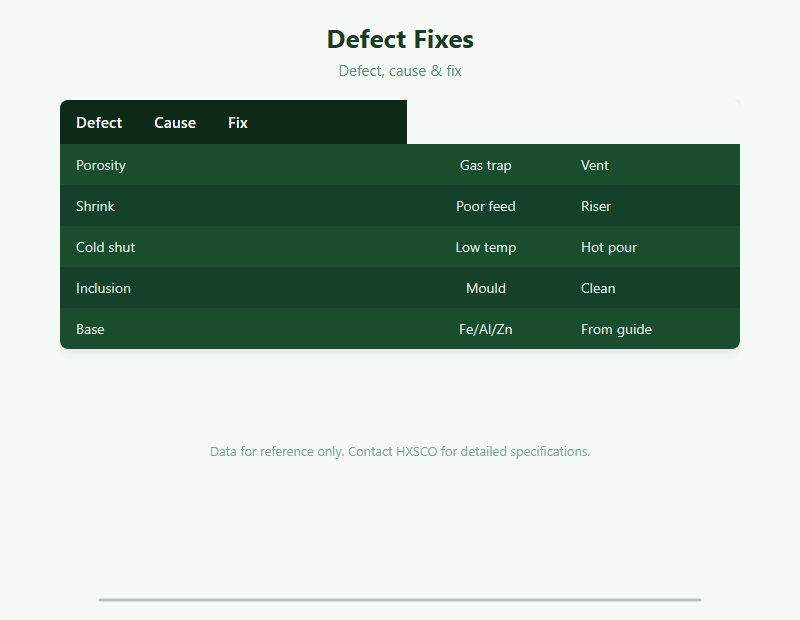
Defect Causes & Fixes
Relate to Metal Sand Casting Guide und Metal Permanent Mold Casting Guide; compare Metal Die Casting Guide und Aluminum Die Casting Guide.
Qualität
Internal soundness checked by Metal Ndt Guide, certified by Mill Test Certificate Guide. Relate to Metal Cast Iron Guide.
Supply & QA
Design for feed via Metal Powder Metallurgy Guide; protect via How To Prevent Metal Rust. HXSCO supplies casting-grade ingot and melt stock.
Get a Quote
Tell HXSCO your requirements and we will respond with a competitive quote and lead time.
Häufig gestellte Fragen
Trapped gas or moisture; improve venting and dry melt.
Unfed solidification; add risers and chills.
Cold metal that failed to fuse; raise pour temperature.
X-ray, dye-penetrant or ultrasound NDT on critical parts.
HXSCO supplies ingot and melt stock for clean castings.
Source Casting-Grade Metal from HXSCO
HXSCO supplies aluminium, zinc and iron casting-grade ingot and melt stock for low-defect castings. Send your alloy and quantity for a quote.