


Short answer: Burnishing cold-works the surface of a metal part with a hard, smooth tool — a roller, ball or diamond — that plastically deforms the asperities into the surface instead of cutting them away, producing a mirror-like, work-hardened, low-friction finish without removing material. It raises surface hardness and fatigue strength, seals porosity and eliminates the swarf and coolant of polishing, making it ideal for hydraulic rods, shafts, bores and medical and food-contact components where a clean, tight-tolerance surface is required.
At a Glance
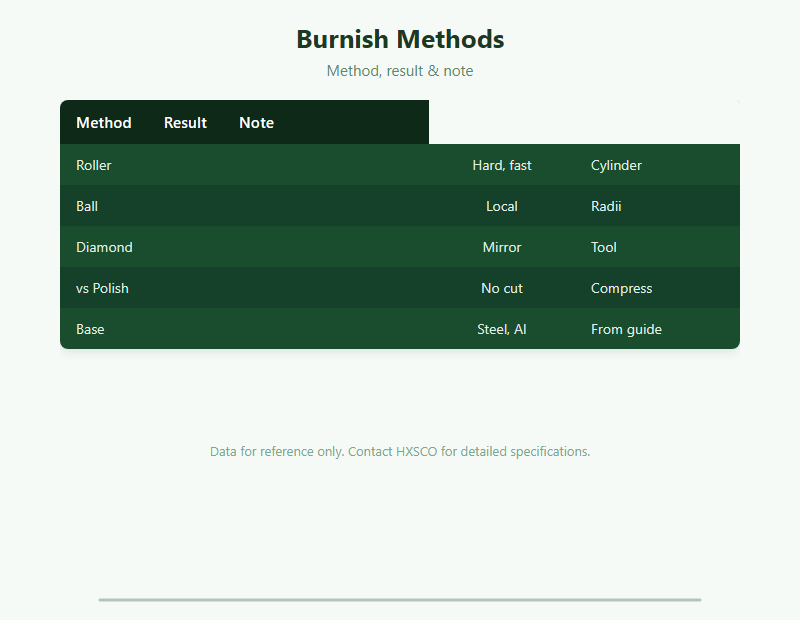
Burnishing vs Other Finishing
Compare Metal Burr Deburring Guide und Metal Vibratory Finishing Guide; relate to Metal Surface Treatment Guide und Metal Hardness Testing Methods.
Qualität
Surface and hardness checked per Surface Roughness Ra Guide, certified by Mill Test Certificate Guide. Inspect by Metal Ndt Guide.
Supply & QA
Start from Metal Machinability Guide und Metal Stamping Vs Machining; protect via How To Prevent Metal Rust. HXSCO supplies burnishing-ready bar and turned parts.
Get a Quote
Tell HXSCO your requirements and we will respond with a competitive quote and lead time.
Häufig gestellte Fragen
Cold-working the surface smooth without removing material.
Burnishing compresses; polishing cuts material away.
Yes — it work-hardens and raises fatigue strength.
Shafts, bores, rollers and radii on turned parts.
HXSCO supplies bar and turned parts ready to burnish.
Source Burnishing-Ready Metal from HXSCO
HXSCO supplies steel, stainless and aluminium bar and turned parts suited to roller and ball burnishing. Send your grade and finish spec for a quote.