


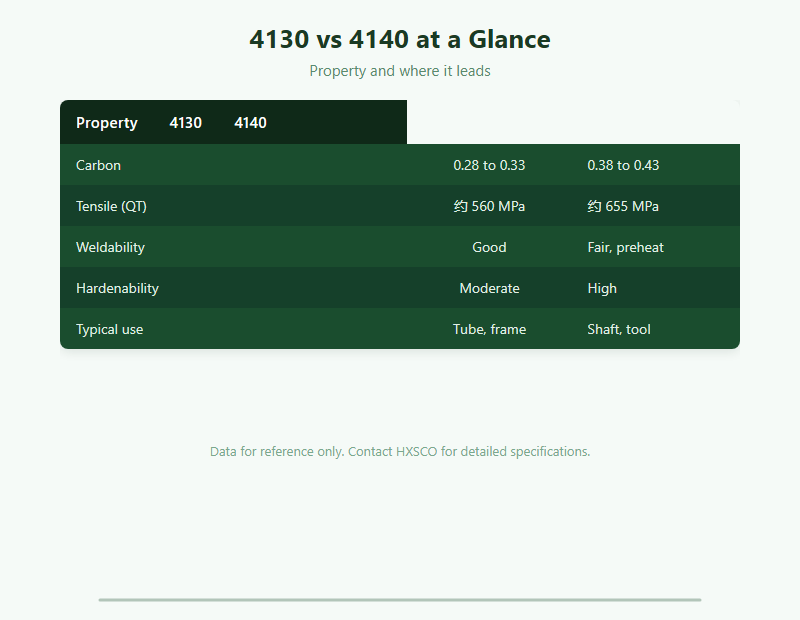
Short answer: Chromium-molybdenum steels 4130 and 4140 differ mainly in carbon, with 4130 at about 0.30 percent carbon welding well for aircraft tubing, frames and pressure parts and 4140 at about 0.40 percent carbon hardening deeper for stronger shafts, gears and tooling, so 4130 is chosen where fabrication and weldability lead and 4140 is chosen where hardness and strength lead, both supplied in the heat-treated condition with mill certificate.
At a Glance
What the Two Steels Are
Both are low-alloy chrome-moly grades, with the basis in our Alloy Steel Supplier and strength notes in our Metal Strength Comparison; hardness detail is in our Hardness Comparison.
Strength and Use
4130 serves welded structures and 4140 serves loaded shafts and tools, with fatigue notes in our Metal Fatigue Guide and automotive context in our Automotive Guide.
Fabrication and Heat Treat
4130 welds readily and 4140 needs preheat and post-weld heat treatment, with the method in our Heat Treatment Guide and machining in our Machining Guide; finish is in our Surface Treatment Guide.
Quality and Sourcing
Alloy stock is checked by inspection, with methods in our Quality Inspection Guide; buyers confirm condition via our Mill Test Certificate Guide and pack per our Export Packing Guide.
Get a Quote
Tell HXSCO your requirements and we will respond with a competitive quote and lead time.
Häufig gestellte Fragen
4130 welds well; 4140 needs preheat and PWHT.
4140 is harder and stronger after quench and temper.
Aircraft tube, bike frames, pressure vessels.
Shafts, gears, collars and tooling.
Confirm condition and certificate, then pack for export.
Specify 4130 or 4140 with HXSCO
HXSCO supplies 4130 and 4140 bar, tube and plate in annealed or quench-tempered condition. Send sizes and condition for a quote.