


Short answer: The galvanic series ranks metals from noble (cathodic) to active (anodic); when two dissimilar metals touch in an electrolyte, the more active one corrodes faster. Keeping couples close in the series — or breaking the electrolyte with insulation and a coating — prevents accelerated attack.
At a Glance
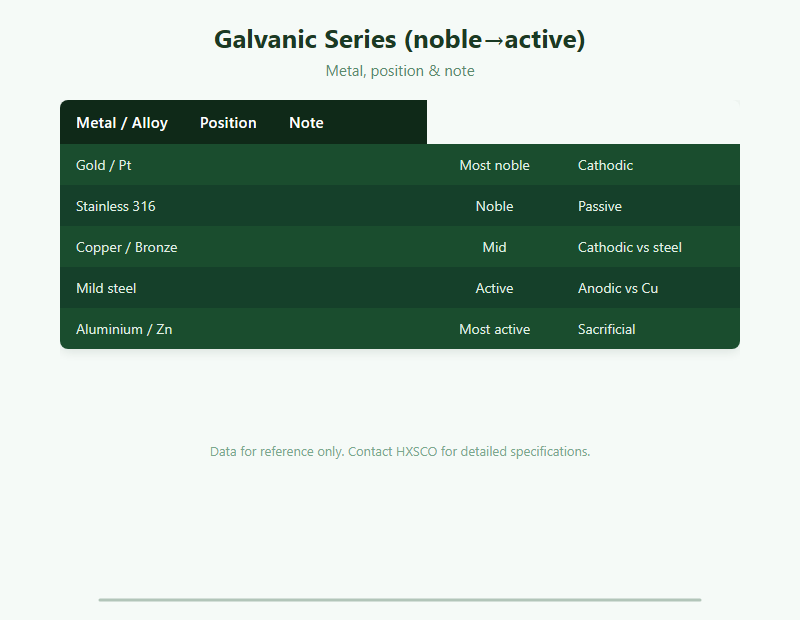
Reading the Galvanic Series
The series orders metals by their electrode potential in seawater or a standard electrolyte. Noble metals (gold, platinum, passive stainless, copper) sit at the cathodic end; active metals (zinc, aluminium, magnesium) sit at the anodic end. The principle drives Galvanic Corrosion Guide and the failure modes in Crevice Corrosion Stainless Steel und Pitting Corrosion Stainless Steel.
How Coupling Drives Corrosion
Join copper to steel and the steel becomes the anode and eats away; join aluminium to stainless and the aluminium sacrifices. The further apart in the series, the larger the driving cell and the faster the attack. This is why Copper Vs Aluminum Wire und Busbar Copper Vs Aluminum specifier choices matter, and why Edelstahlsorten erklärt selection must consider passivity.
Designing Out Galvanic Attack
Keep couples close in the series, insulate the joint with non-conductors, apply a continuous coating to the anodic member, or fit a deliberate sacrificial anode (zinc) — the tactic behind Cathodic Protection Guide and the inhibitors in Metal Corrosion Inhibitor Guide. Drain and dry designs beat sealed electrolytes; verify with How To Prevent Metal Rust.
Get a Quote
Tell HXSCO your requirements and we will respond with a competitive quote and lead time.
Häufig gestellte Fragen
A ranking of metals and alloys by electrode potential — from noble (cathodic) to active (anodic) — that predicts which one corrodes when two are joined in an electrolyte.
The more active (anodic) metal, the one lower in the series — e.g. steel under copper, or aluminium under stainless — corrodes faster.
Greater separation means a bigger driving voltage and faster attack; couples more than a few steps apart (e.g. aluminium to copper) need insulation or a sacrificial anode.
Passive stainless is noble and usually stays safe, but it can suffer pitting if the electrolyte is aggressive — see our pitting and crevice guides.
Keep couples close in the series, insulate the joint, coat the anodic member, or add a sacrificial zinc anode; design to break the electrolyte path.
Source Galvanically-Smart Metal from HXSCO
HXSCO supplies matched, corrosion-aware grades (stainless, aluminium, copper, galvanised) and can advise on coupling and coatings. Send your assembly and quantity for a quote.