


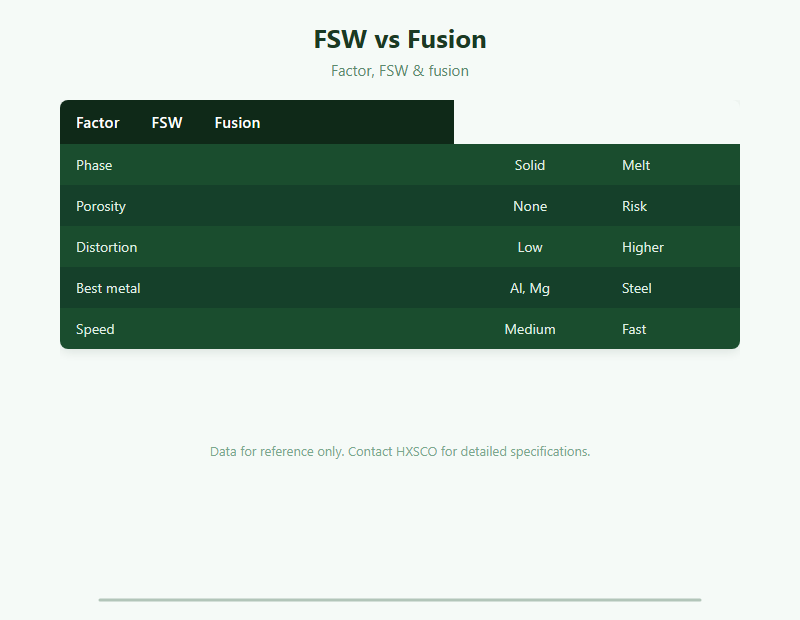
Short answer: Friction stir welding (FSW) is a solid-state process that rotates a non-consumable pin through the joint to plasticise and forge the metal together — giving porosity-free, low-distortion welds especially prized for aluminium and other hard-to-fusion-weld alloys.
At a Glance
How the Stir Works
A spinning tool’s shoulder heats and the pin stirs the plasticised metal behind it; no melt means no solidification cracks. Background in Alüminyum Nasıl Kaynak Yapılır, How To Weld Stainless Steel ve How To Weld Carbon Steel; compare with Metal Tig Vs Mig Welding Guide ve Metal Resistance Welding Guide.
Where FSW Wins
Ship panels, rail cars and heat exchangers gain quiet, strong seams; manage heat with Metal Heat Affected Zone Guide, distortion with Metal Welding Distortion Guide, and prep per Weld Edge Prep Guide. Tie strength to Yield Strength Vs Tensile Strength.
QA & Supply
Find lack-of-penetration and kissing bonds by Metal Ndt Guide; avoid defects per Weld Defects Guide; select alloy per Aluminum Alloy Series Guide and document per Mill Test Certificate Guide. HXSCO supplies weld-ready plate and sheet.
Get a Quote
Tell HXSCO your requirements and we will respond with a competitive quote and lead time.
Sıkça Sorulan Sorular
A solid-state process that stirs plasticised metal together with a rotating pin — no melting.
Aluminium’s oxide and hot cracking make fusion welding hard; FSW avoids both.
Generally no — without a molten pool there is no gas porosity.
It can, but tool wear is high; steel is usually fusion welded instead.
HXSCO supplies aluminium and steel plate and sheet prepared for friction stir welding.
Source FSW-Ready Metal from HXSCO
HXSCO supplies aluminium and steel plate and sheet prepared for friction stir welding with certificates. Send your alloy and quantity for a quote.