


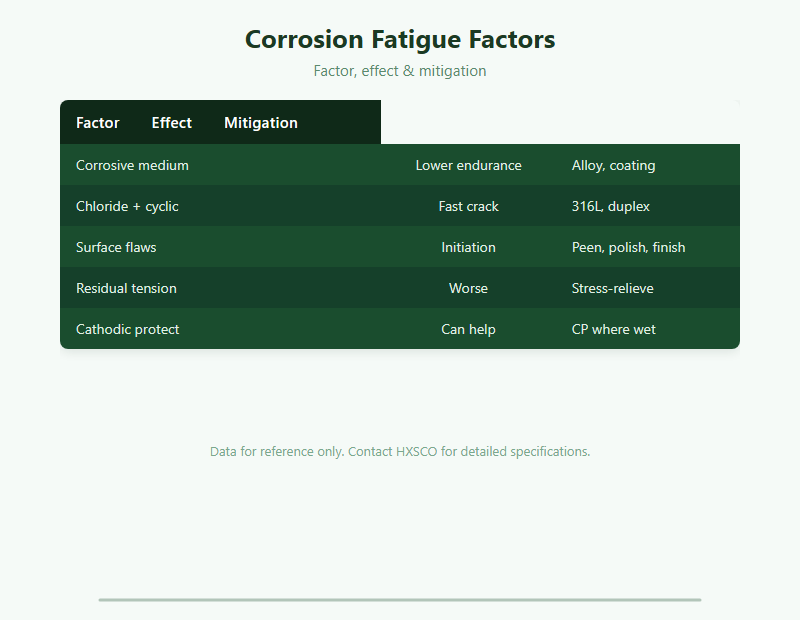
Short answer: Corrosion fatigue is the combined attack of a cyclic load and a corrosive environment, which together drive cracks at stresses far below the dry fatigue limit; it is prevented by corrosion-resistant alloys, smooth finishes, compressive surface stress (peening) and coatings or cathodic protection.
At a Glance
Mechanism
Dry fatigue has an endurance limit (see Metal Fatigue Endurance Limit); add a corrosive medium and that limit can vanish, because corrosion pits and attack the crack tip, letting cracks grow at much lower stress. It is the union of fatigue and Galvanic Corrosion Guide, and it explains many marine and process failures that neither mechanism alone would cause. The localised forms it interacts with are Pitting Corrosion Stainless Steel e Crevice Corrosion Stainless Steel.
Susceptible Alloys and Environments
Carbon and low-alloy steels are highly susceptible in water and salt; aluminium and copper alloys less so but still affected. Resistance improves sharply with Stainless Steel 316 Properties (molybdenum), Duplex Stainless Steel Guide and nickel alloys, and with titanium (see Titanium Vs Steel). The grade choice mirrors Stress Corrosion Cracking because both need a resistant alloy and low residual stress.
Prevention
Specify a corrosion-resistant grade for the medium, keep surfaces smooth and passivated (see Stainless Steel Surface Finishes), induce compressive stress by Shot Peening Guide, stress-relieve welds per Stress Relieving Vs Annealing, and add coatings or Cathodic Protection Guide where wet. Every lot is confirmed by the certificate in Mill Test Certificate Guide.
Get a Quote
Tell HXSCO your requirements and we will respond with a competitive quote and lead time.
Perguntas frequentes
Corrosion fatigue is cracking caused by the combined action of a cyclic load and a corrosive environment, which grows cracks at stresses far below the dry fatigue limit.
Resistance rises with alloy: 316L, duplex stainless, nickel alloys and titanium resist far better than carbon steel in chloride and wet service.
Use a corrosion-resistant grade, keep surfaces smooth and passivated, shot-peen for compressive stress, stress-relieve, and apply coatings or cathodic protection.
Yes. Shot peening puts the surface in compression, which slows crack initiation and improves corrosion-fatigue life.
Specify CF-Resistant Metal from HXSCO
HXSCO supplies corrosion-fatigue-resistant grades (316L, duplex, nickel, titanium) with peening and mill certificates. Send your cyclic-load and medium for a quote.