



Short answer: Common die casting defects – gas porosity, shrinkage, cold shuts, flow marks, flash and inclusions – trace to gating, venting, temperature or die condition and are controlled by process discipline and inspection, as covered in our Die Casting Guide.
At a Glance
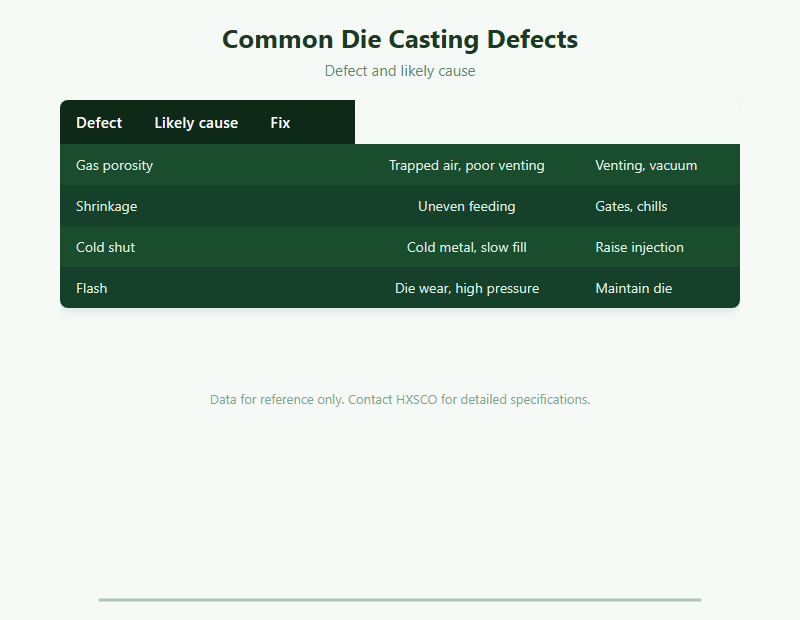
Why Die Casting Defects Happen
Defects arise from melt quality, injection parameters, die condition and venting; the process stages are in our Die Casting Guide.
Porosity and Shrinkage
Gas porosity comes from trapped air and shrinkage from solidification; vacuum assist and good gating help; detection is in our Inspection Guide and the casting basis in our Metal Casting Guide.
Cold Shuts and Flow Marks
Cold metal or slow filling freezes the stream before it fuses; gating and temperature control are the fix, with die design in our Mold Design Guide.
Flash, Inclusions and Surface Defects
Flash comes from die wear or excess pressure, inclusions from melt contamination; finishing options are in our Finishing Guide.
Prevention Through Process Control
Stable parameters, die maintenance and layered inspection prevent recurrence; third-party checks are in our Third-Party Inspection Guide.
Inspection and Documentation
Results are documented per our Mill Test Certificate Guide; the broader quality approach is in our Quality Inspection Guide.
Get a Quote
Tell HXSCO your requirements and we will respond with a competitive quote and lead time.
Perguntas frequentes
Small gas holes trapped during filling.
Better venting, vacuum assist and clean melt.
Metal cooling before two streams fuse.
Thin excess metal squeezed out of the die.
Yes – see our quality inspection guide.
Source Quality Die Castings
HXSCO supplies inspected die castings with foundry and third-party certificates. Send your drawing and quality requirements for a quote.