


Short answer: Thermal fatigue is cracking from repeated heating and cooling that makes a component expand and contract against constraints; it is controlled by limiting temperature swings, choosing ductile grades, allowing movement and using thermal-barrier coatings.
At a Glance
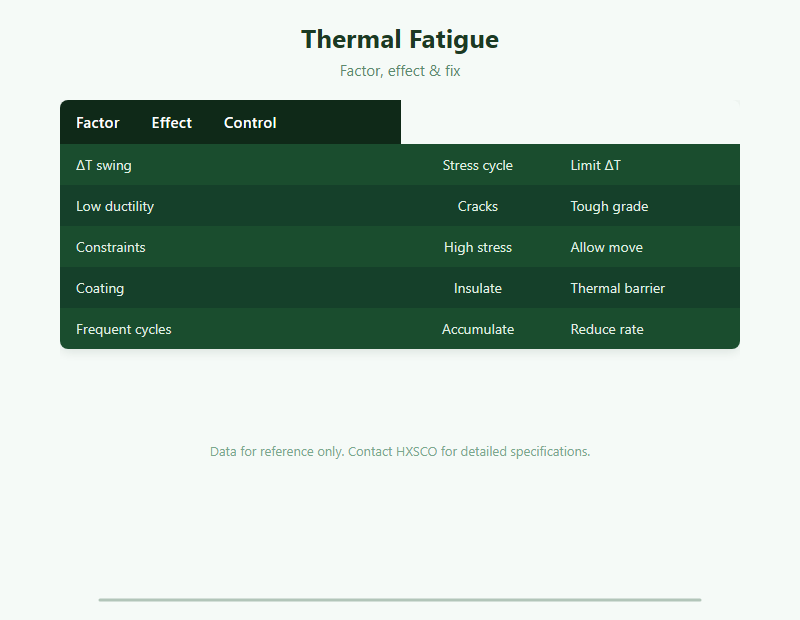
How Thermal Fatigue Cracks Form
Each heat-cool cycle stresses the surface as it wants to expand but is held by cooler, stiffer material; repeated cycles open cracks. It is the thermal cousin of Metal Fatigue Endurance Limit en Metal Creep Guide, and worsens where Metal Corrosion Fatigue Guide of Metal High Temperature Oxidation Guide act together. Constraint design matters as in Stress Concentration Guide (if used) and Metal Residual Stress Guide.
Vulnerable Components
Furnace parts, dies, turbine shrouds, brake discs, heat-exchanger headers and engine exhaust see the worst duty. Material choice helps: Nickel Alloy Supplier, Hastelloy Guide, Inconel Vs Hastelloy Guide en Refractory Metals Supplier resist high-temperature cycling; Casting Supplier is less ductile. Context from Stainless Steel 316 Properties en Duplex Stainless Supplier.
Mitigation & QA
Lower ΔT, slow heat-up, use ductile/low-expansion alloys (Thermal Expansion Of Metals), allow free movement, and apply thermal-barrier coatings via Metal Surface Treatment Guide. Inspect with Metal Ndt Guide en Metal Hardness Testing Methods, and certificate per Mill Test Certificate Guide. Vulnerable parts such as Casting Supplier are less ductile and need care.
Get a Quote
Tell HXSCO your requirements and we will respond with a competitive quote and lead time.
Veelgestelde vragen
Cracking caused by repeated heating and cooling that makes a constrained component expand and contract, accumulating strain each cycle.
Furnace parts, dies, turbine shrouds, brake discs, exhaust manifolds and heat-exchanger headers.
Ductile, high-temperature alloys such as nickel alloys, Hastelloy, Inconel and some stainless/duplex grades; low-expansion helps.
Limit temperature swing and cycle rate, allow movement, choose tough/low-expansion grades and apply thermal-barrier coatings.
HXSCO supplies nickel alloys, Hastelloy, Inconel and heat-resistant stainless with certificates for cyclic thermal duty.
Source Thermal-Cycle Alloys from HXSCO
HXSCO supplies nickel alloys, Hastelloy, Inconel and heat-resistant stainless for thermal-fatigue duty, with certificates. Send your temperature swing and quantity for a quote.