


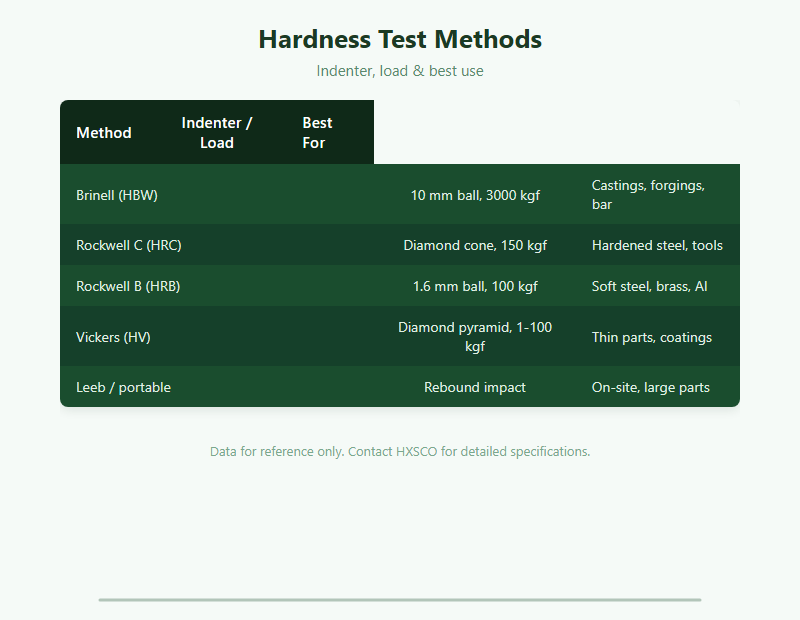
Short answer: Brinell uses a large ball and heavy load for coarse-grained castings and bar, Rockwell gives a fast direct reading for production control (HRC on hardened steel, HRB on soft metals), Vickers uses a diamond pyramid at any load for thin sections and coatings, and portable Leeb testers cover parts too large for a bench machine.
At a Glance
Why Hardness Is Measured
Hardness is resistance to permanent indentation, and it proxies for strength, wear resistance and heat-treat condition without destroying the part. It is the fastest way to confirm a quench-and-temper cycle landed correctly — the routes are in Stress Relieving Vs Annealing, Annealing Vs Normalizing en Nitriding Vs Carburizing — and to accept incoming Steel Plate Supplier of Wear Resistant Steel Supplier material.
Method by Method
Brinell (HBW) — 10 mm carbide ball at 3000 kgf leaves a large impression that averages over coarse structures, so it suits Casting Supplier en Forging Supplier product. Rockwell — measures indentation depth directly for a fast dial reading; HRC (diamond cone, 150 kgf) for hardened steel and Maraging Steel Guide grades, HRB (ball, 100 kgf) for soft steel, brass and aluminum. Vickers (HV) — one diamond pyramid across all loads, so micro-loads can measure case depth, coatings from Thermal Spray Coating Guide or thin strip. Conversions between scales are tabulated in Hardness Conversion Chart.
Getting a Valid Reading
Prepare a flat, clean, un-decarburised surface; support the part rigidly; keep indentations at least 2.5 diameters from an edge and from each other; and never test through a coating unless the coating is the subject. Thin sections need Vickers or superficial Rockwell so the anvil does not influence the result. Report the scale with the number (e.g. 240 HBW or 45 HRC) — a bare figure is ambiguous. Certificates on our material follow Mill Test Certificate Guide, and grain effects are explained in Grain Structure Metals.
Get a Quote
Tell HXSCO your requirements and we will respond with a competitive quote and lead time.
Veelgestelde vragen
Brinell uses a 10 mm ball at heavy load and measures impression width; Rockwell measures indentation depth for a direct dial reading; Vickers uses a diamond pyramid at any load, making it suitable for thin parts and coatings.
Rockwell C (HRC) is the standard for hardened steel above about 20 HRC; Vickers is preferred when the section is thin or a case depth profile is needed.
Approximately. Conversions between HB, HRC, HRB and HV are tabulated in standards such as ASTM E140, but they are estimates and should not replace a test on the required scale.
For steel, tensile strength is roughly 3.4 times the Brinell number in MPa. It is a useful estimate, not a substitute for a tensile test.
Need Certified Hardness Data?
HXSCO supplies steel, stainless and alloy material with hardness and mechanical test reports on the scale you specify. Send your grade and requirement for a quote.