


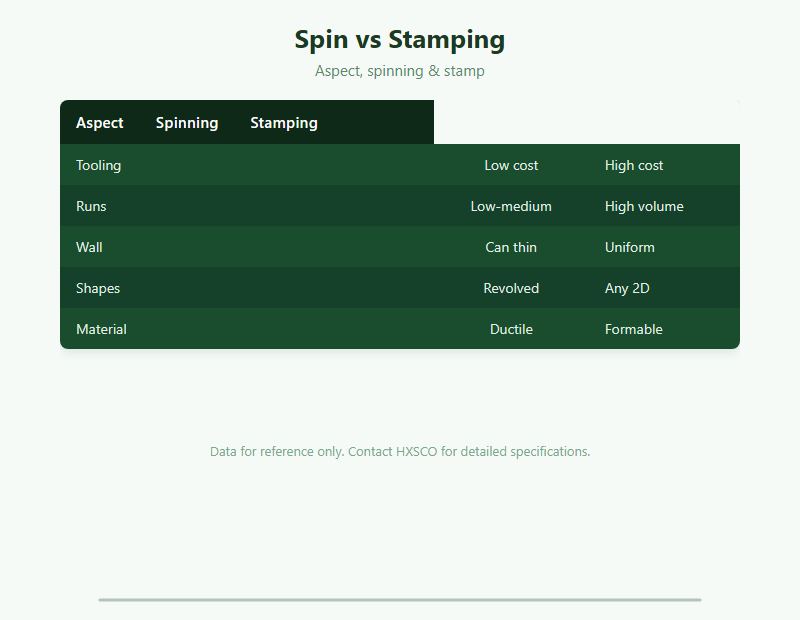
Short answer: Metal spinning forms axisymmetric parts by pressing a spinning disc or tube of sheet against a rotating mandrel — a low-tooling, highly ductile process ideal for cones, domes, vessels and reflectors in low to medium runs.
At a Glance
How Spinning Works
A blank spins on a lathe while a roller presses it onto a mandrel, flowing metal into the shape without a closing die. It is gentler than Metal Stamping Supplier and pairs with Metal Bending Guide; forming limits follow Metal Formability Guide en Aluminum Temper Designations.
Spinning vs Other Forming
Tooling is far cheaper than stamping dies, so spinning suits prototypes and medium runs of revolved parts (compare Casting Supplier en Forging Supplier). Flow forming thins and elongates the wall for strength — context for Yield Strength Vs Tensile Strength en Metal Strain Hardening Guide.
Materials, QA & Supply
Aluminium (Aluminum Alloy Series Guide), stainless (Uitleg over roestvast staal), copper (Copper Alloys Guide) and mild steel spin well. Verify dimensions per Metal Tolerances Fits Guide, finish per Surface Roughness Ra Guide and record per Mill Test Certificate Guide.
Get a Quote
Tell HXSCO your requirements and we will respond with a competitive quote and lead time.
Veelgestelde vragen
Forming axisymmetric parts by pressing a spinning sheet or tube against a rotating mandrel with a roller.
For low-to-medium runs and prototypes where die tooling cost would be hard to justify.
Cones, domes, cylinders, vessels and reflectors — anything with rotational symmetry.
Ductile metals: aluminium, stainless, copper and mild steel in suitable tempers.
Flow forming can thin and elongate the wall, increasing strength along the part.
Source Spun & Formed Parts from HXSCO
HXSCO supplies spun, flow-formed and stamped revolved parts with documented dimensions and finish. Send your drawing and quantity for a quote.