



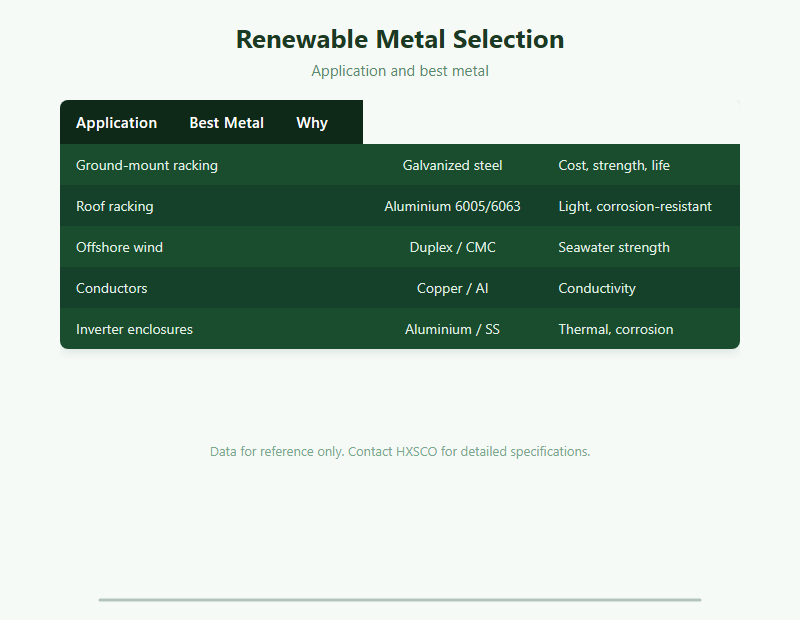
Short answer: Renewable energy leans on galvanized steel for ground-mount solar racking, aluminium for roof racking and enclosures, duplex stainless and copper-nickel for offshore wind in seawater, and copper (with aluminium) for every electrical conductor from panel to grid. Selection balances life, weight and conductivity against environment.
At a Glance
Solar Racking and Mounts
Ground-mount arrays use hot-dip galvanized steel for low cost and long life (our Galvanized Supplier en Hot-Dip Galvanizing Guide); roof systems use aluminium 6005/6063 for light weight (our Aluminium Extrusion Supplier). Corrosion planning follows our Atmospheric Corrosion Guide.
Offshore Wind and Tidal
Subsea and splash-zone components need duplex stainless (our Duplex Supplier) and copper-nickel (our Copper-Nickel Supplier) to survive seawater; selection logic is in our Seawater Corrosion Guide en Marine Applications Guide.
Conductors and Busbars
Every renewable system needs conductors: copper busbars (our Copper Busbar Guide) and aluminium conductors sized from our Electrical Conductivity Guide. Inverter enclosures use aluminium or stainless for thermal and corrosion performance.
Lifecycle and Quality
Renewable assets run 20–30 years, so coatings, tolerances and certificates matter. Verify with our Coating Thickness Guide, Tolerances Fits Guide en Mill Test Certificate Guide so structures meet design life without premature failure.
Get a Quote
Tell HXSCO your requirements and we will respond with a competitive quote and lead time.
Veelgestelde vragen
Galvanized steel for ground-mount, aluminium for roof systems.
Duplex stainless and copper-nickel for seawater duty.
It is the premier electrical conductor from panel to grid.
20–30 years, so coating and grade are critical.
Yes — light, corrosion-resistant inverter housings.
Supply Renewable-Energy Metal from HXSCO
HXSCO supplies galvanized steel, aluminium extrusions, duplex, copper-nickel and copper for solar and wind projects. Send your BOM for a quote.