


Short answer: HXSCO arranges surface hardening that adds a hard, wear-resistant case to a tough core through carburizing, carbonitriding, nitriding, induction and flame hardening, alongside our Heat Treatment Supplier page and the coating options in our Surface Finishing Guide.
At a Glance
Our Surface Hardening Range
We arrange case-hardening and through-hardening of rotating and sliding parts, with base stock from our Carbon Steel Supplier e Stainless Steel Supplier pages and matching service in our Heat Treatment Supplier page.
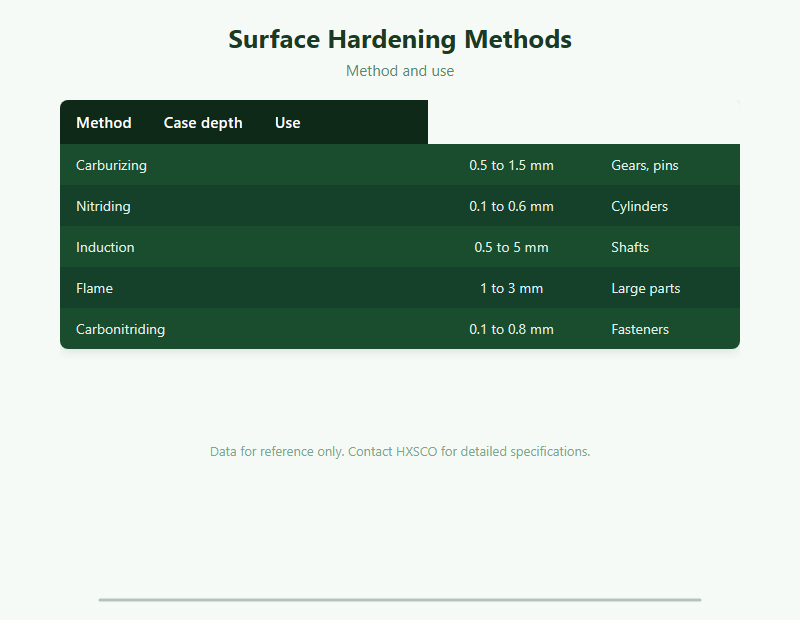
| Method | Case depth | Use |
|---|---|---|
| Carburizing | 0.5 to 1.5 mm | Gears, pins |
| Nitriding | 0.1 to 0.6 mm | Cylinders |
| Induction | 0.5 to 5 mm | Shafts |
| Flame | 1 to 3 mm | Large parts |
| Carbonitriding | 0.1 to 0.8 mm | Fasteners |
Choosing a Method
Carburizing and carbonitriding suit small loaded parts, nitriding gives low distortion and induction suits selective shaft hardening, with the property basis in our Hardness and Tensile Guide.
Core and Case Balance
A soft tough core resists shock while a hard case resists wear; verify each lot with our Quality Inspection Guide and documents per our Mill Test Certificate Guide.
Finishing and Protection
After hardening, coatings such as zinc or black oxide add corrosion resistance, with the options in our Surface Finishing Guide and the galvanized view in our Galvanized Steel Buyers Guide.
Ordering and Lead Time
Share part type, material and case depth; plan with our MOQ and Lead Time Guide and price with our Price Quotation Guide.
Get a Quote
Tell HXSCO your requirements and we will respond with a competitive quote and lead time.
Domande frequenti
Carburizing or carbonitriding.
Nitriding at low temperature.
Induction hardening.
0.1 to 5 mm by method.
Yes – microhardness profile on request.
Arrange Surface Hardening with HXSCO
HXSCO arranges carburizing, nitriding and induction hardening for your parts with case-depth reports. Send part type, material and case depth for a quote.