


Short answer: The recrystallization temperature is the temperature at which cold-worked metal forms new strain-free grains, removing hardness and restoring ductility; it rises with alloy content, prior cold work and purity, and is the key to annealing, softening and controlling grain size.
At a Glance
Recovery, Recrystallization, Grain Growth
On heating, the metal first recovers (stress relief), then nucleates new equiaxed grains (recrystallization) and finally grows them (grain growth). This underpins Stress Relieving Vs Annealing, Annealing Vs Normalizing e Metal Heat Treatment Guide; the resulting structure is read in Grain Structure Metals e Metal Grain Flow Guide.
What Shifts the Temperature
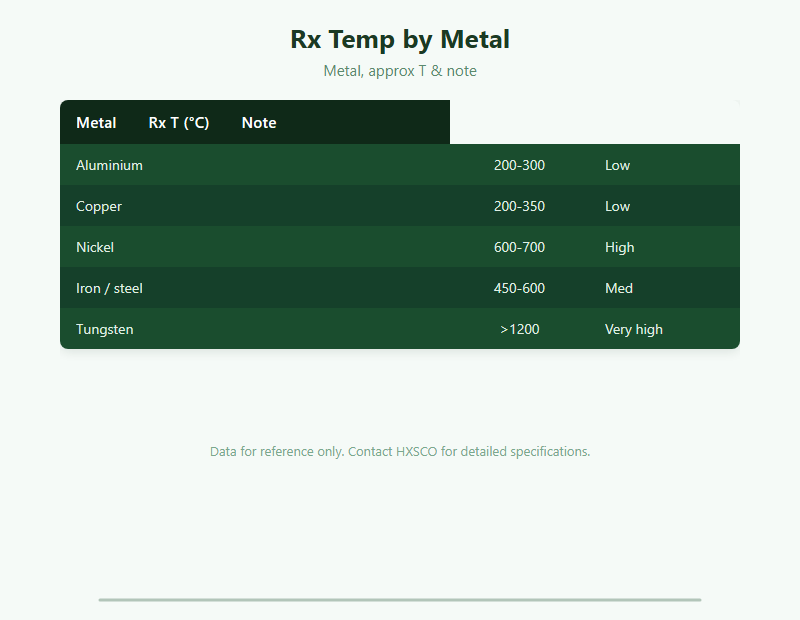
More cold work lowers the recrystallization temperature; higher purity lowers it; alloying and fine dispersoids raise it. Context for Cold Rolling Vs Hot Rolling, Metal Formability Guide e Aluminum Temper Designations; compare Copper Alloys Guide, Nickel Supplier e Gradi di acciaio inossidabile spiegati.
Controlling Properties
Anneal just above the recrystallization temperature for soft, fine-grained stock; over-anneal and grains coarsen (see Grain Structure Metals). Verify hardness and grain with Metal Hardness Testing Methods e Metal Ndt Guide, and certificate per Mill Test Certificate Guide.
Get a Quote
Tell HXSCO your requirements and we will respond with a competitive quote and lead time.
Domande frequenti
The temperature at which cold-worked metal forms new strain-free grains, removing work hardening and restoring ductility.
Stored dislocation energy provides nucleation sites, so less heat is needed to start new grains.
Generally yes — solutes and second phases pin boundaries, so alloys recrystallize at higher temperatures than pure metals.
New grains form and then grow; too much time or temperature gives coarse grains and lower strength.
HXSCO supplies annealed, soft-temper strip, sheet and wire with documented grain and hardness per your process.
Source Annealed Metal from HXSCO
HXSCO supplies annealed, fine-grained strip, sheet and wire with documented recrystallized condition. Send your alloy, temper and quantity for a quote.