



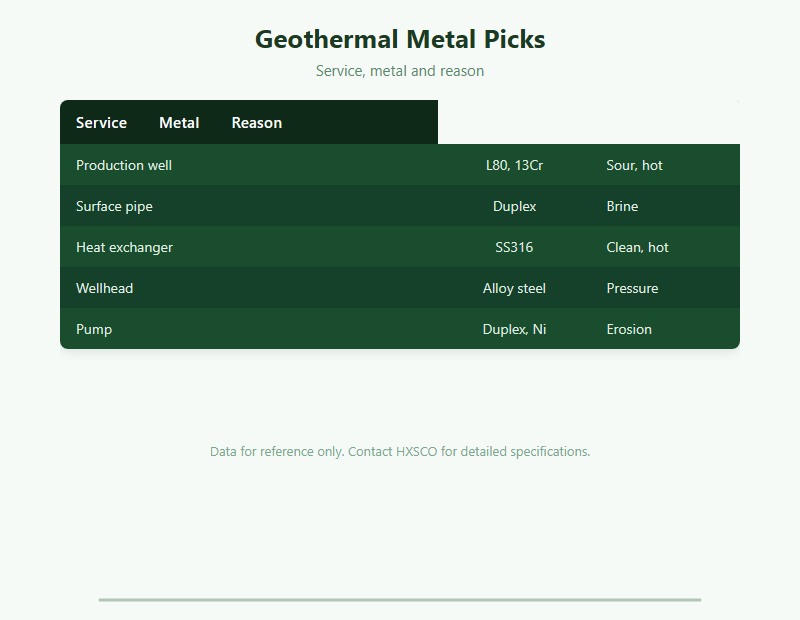
Short answer: Geothermal systems use carbon and 13Cr casing in the well, duplex and 316 stainless in surface piping and heat exchangers for brine and scaling resistance, and nickel alloys in the hottest, most corrosive pump and wellhead parts, balancing cost against temperature and chloride exposure.
At a Glance
The Geothermal Challenge
Brine, carbon dioxide, hydrogen sulphide and high temperature attack the metal, so alloy choice is critical, with data in our Corrosion Resistance Guide and grade map in our Nickel Alloy Grades Guide.
Well and Surface Piping
Casing uses carbon and 13Cr steel, while surface lines use duplex for brine, detailed in our Piping and Pipeline Guide and the duplex page in our Duplex Stainless Supplier.
Heat Exchangers and Pumps
316 and duplex resist scaling and erosion, with design in our Pumps and Valves Guide and heat duty in our Power Generation Guide; welding is in our Welding Joining Guide.
Standards and Sourcing
High-temperature and sour-service grades follow NACE and ASTM rules, with checks in our Standards Comparison Guide; certification is in our Mill Test Certificate Guide and packing in our Export Packing Guide.
Get a Quote
Tell HXSCO your requirements and we will respond with a competitive quote and lead time.
Domande frequenti
Duplex and 316 stainless resist the chloride and scaling in surface brine lines.
Nickel alloys survive the hottest, most corrosive pump and wellhead parts.
Carbon and 13Cr casing handle the hot, sometimes sour well environment.
Scaling insulates and pits; stainless and smooth finishes reduce buildup.
PMI and EN 10204 3.1 certificate confirm chemistry and service rating.
Source Geothermal Metal with HXSCO
HXSCO supplies duplex, 316 stainless, 13Cr and nickel alloys for geothermal wells, exchangers and pumps. Send your service conditions for a quote.