


Short answer: Corrosion rate is most often calculated from weight-loss coupons as mass loss over area and time, expressed in mm/year or mils per year then converted to penetration; electrochemical methods such as LPR and EIS give instant or film-resolved readings for online monitoring.
At a Glance
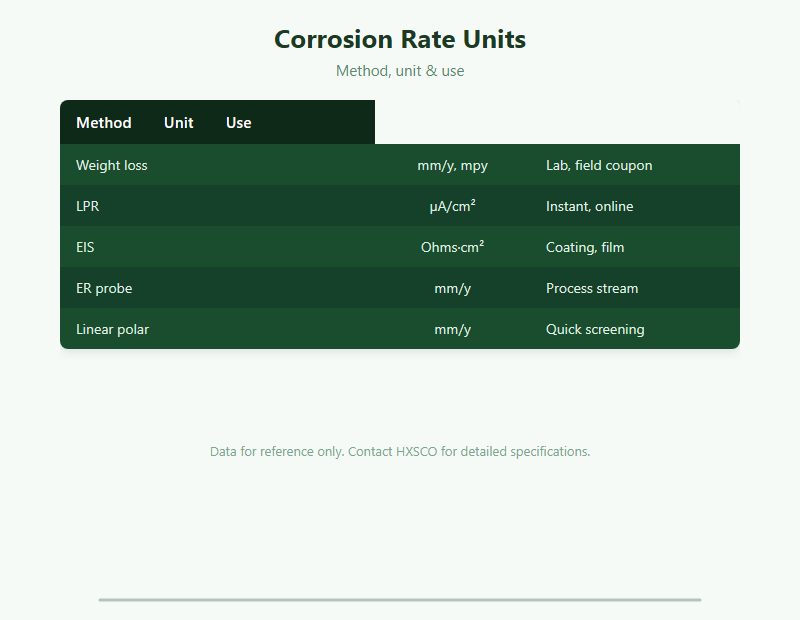
Weight-Loss Method
The classic approach exposes a cleaned, weighed coupon to the environment for a known time, then computes penetration from the mass lost: rate (mm/y) = K · mass-loss / (area · time · density). It integrates all mechanisms — Galvanic Corrosion Guide, Pitting Corrosion Stainless Steel, Crevice Corrosion Stainless Steel — and is the field reference for plant risk. Damage is later inspected with Metal Ndt Guide and under insulation with Metal Corrosion Under Insulation.
Electrochemical Methods
Linear polarisation resistance (LPR) gives an instant rate from the polarisation slope; electrochemical impedance spectroscopy (EIS) separates coating and film effects, useful where Stainless Steel Surface Finishes o Passivation Vs Pickling dominate. Both need calibration against weight loss. Sensitised stainless can give misleading reads if Intergranular Corrosion Stainless is active, and chloride duty must account for Stress Corrosion Cracking.
Using the Rate
Turn the rate into a remaining-life or inspection interval, and feed it back into protection design: coatings, cathodic protection and material choice per How To Prevent Metal Rust, or account for corrosion-fatigue interaction via Metal Corrosion Fatigue Guide. Report the method and basis with the Mill Test Certificate Guide for the alloy.
Get a Quote
Tell HXSCO your requirements and we will respond with a competitive quote and lead time.
Domande frequenti
Measure the coupon mass lost over a known exposure area and time, then rate (mm/y) = K · mass-loss / (area · time · density), with K the unit-conversion constant.
mpy is mils (thousandths of an inch) per year; mm/y is millimetres per year. Roughly 1 mm/y ≈ 39.4 mpy. Both express metal penetration rate.
Linear polarisation resistance applies a small potential sweep and derives an instant corrosion rate from the slope; it is used for online monitoring but must be calibrated against weight-loss data.
It sets a corrosion allowance, remaining-life estimate and inspection interval, and decides whether coatings, cathodic protection or a more resistant alloy is needed.
Yes. HXSCO supplies test coupons and the corrosion-resistant alloys above with mill certificates for qualification testing.
Source Corrosion-Resistant Alloys from HXSCO
HXSCO supplies corrosion-test coupons and resistant alloys (304, 316, duplex, nickel) with mill certificates. Send your environment and quantity for a quote.