



Short answer: Cold isostatic pressing (CIP) compacts metal powder uniformly from all sides in a flexible mould under fluid pressure — giving denser, more uniform green parts than uniaxial pressing, with no density gradient. It is the standard first step for PM billets, rods, tubes and near-net shapes that are later sintered or hot-isostatically pressed.
At a Glance
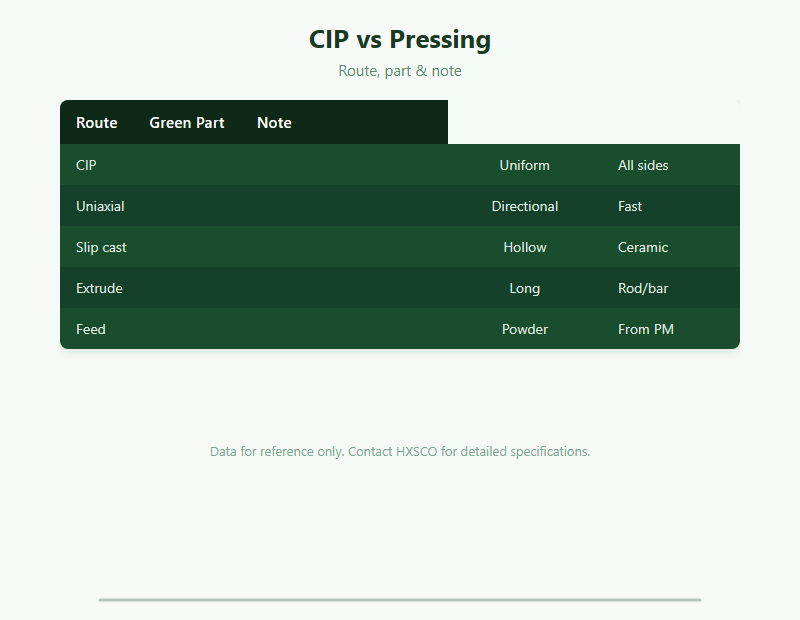
Choosing the Route
CIP pairs with Metal Powder Metallurgy Guide e Metal Powder Supplier; later densify by Metal Hot Isostatic Pressing Guide. Compare with Metal Cold Forging Guide e Metal Deep Drawing Guide.
Quality Levers
Pressure and dwell set green density; inspect by Metal Ndt Guide and document per Mill Test Certificate Guide. Protect powder via How To Prevent Metal Rust.
QA & Supply
HXSCO supplies PM-grade powders and preforms to your specification.
Get a Quote
Tell HXSCO your requirements and we will respond with a competitive quote and lead time.
Domande frequenti
Compacting powder uniformly from all sides in a flexible mould.
CIP gives uniform density; uniaxial has a directional gradient.
PM billets, rods, tubes and near-net preforms.
Sintering, then optionally hot isostatic pressing.
HXSCO supplies iron, copper, aluminium and titanium powders for CIP.
Source PM Powder from HXSCO
HXSCO supplies iron, copper, aluminium and titanium powders suited to cold isostatic pressing. Send your grade and quantity for a quote.