


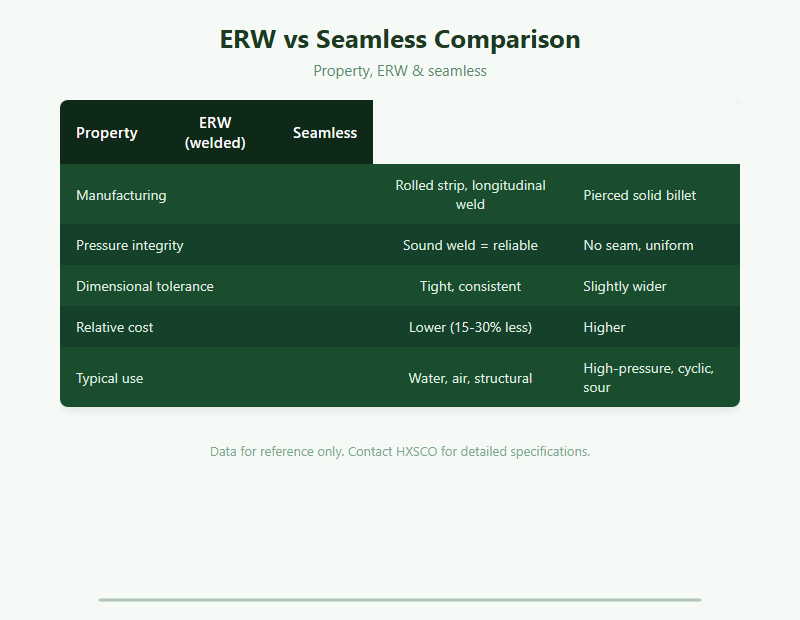
Short answer: ERW (electric resistance welded) pipe is made by rolling strip and welding a single longitudinal seam, giving tight tolerances at lower cost for general water, air and structural duty; seamless pipe is pierced from a solid billet with no seam, making it the choice for high pressure, cyclic loading, sour service and tight radiographic acceptance.
At a Glance
How Each Pipe Is Made
ERW starts from a coiled strip that is rolled into a round and joined by a longitudinal electric-resistance weld, then sized and heat-treated to normalize the seam. It is produced in very consistent diameters and wall profiles, which is why it dominates utility and structural piping supplied through our Steel Pipe Supplier programme. Seamless pipe is extruded or pierced from a solid billet and then elongated and drawn, leaving a homogeneous wall with no weld line. The two dominant carbon specifications and how they apply to both routes are covered in Astm A53 Vs A106 Steel Pipe, and pressure class is set by wall schedule, measured per How To Measure Steel Pipe Size.
Strength, Integrity and Inspection
A modern ERW weld, properly processed and inspected by eddy current or ultrasound, is as reliable as the parent metal for the vast majority of services, and ERW is preferred wherever cost and tight tolerance matter. Seamless wins where a single defect-free path is mandatory: high-pressure steam and hydrogen, cyclic and fatigue loading, sour (H2S) environments and applications requiring 100% radiography with zero allowable seam indications. Grade and test requirements appear on the certificate described in Mill Test Certificate Guide; for pipe that must also resist corrosion, pair either route with the coating choices in Black Steel Vs Galvanized Pipe.
Choosing by Actual Service
Specify ERW for fire protection, compressed air, HVAC, water and structural columns where the seam is not the limiting factor. Choose seamless for boiler and superheater tubes, high-pressure process lines, drilling and offshore risers, and any duty with shock, vibration or sour gas. Remember that corrosion allowance and schedule matter as much as the seam type — see the wall-thickness planning in How To Prevent Metal Rust — and that a welded seam is not a weakness if the service was correctly classified. HXSCO supplies both routes in carbon, alloy and stainless with the inspection level your code demands.
Get a Quote
Tell HXSCO your requirements and we will respond with a competitive quote and lead time.
Domande frequenti
ERW pipe has a single longitudinal electric-resistance weld made from rolled strip; seamless pipe is pierced from a solid billet with no seam. Seamless is chosen for the most demanding pressure and integrity services, ERW for general and structural duty.
For most services a properly inspected ERW weld is as strong as the parent metal, but seamless is specified where a defect-free wall is mandatory — high pressure, cyclic load, sour gas and full-radiography acceptance.
ERW is typically 15-30% cheaper and has tighter dimensional tolerance; seamless costs more because of the billet-piercing process and is justified by the service severity.
Yes. HXSCO supplies ERW and seamless steel pipe in carbon, alloy and stainless, in the schedule and inspection level your specification requires, with mill certificates.
Order ERW or Seamless Pipe from HXSCO
HXSCO supplies ERW and seamless steel pipe from SCH 5S to XXS in carbon, alloy and stainless, with the inspection level you need. Send NPS, schedule and grade for a quote.