


Short answer: Clad steel plate is a bimetal that bonds a low-cost strong base (carbon or alloy steel) to a thin corrosion-resistant layer (stainless, titanium or nickel alloy) for vessels and tanks, related to the base in our Carbon Steel Supplier page and the corrosion view in our Duplex Stainless Guide.
At a Glance
What Clad Steel Plate Is
Clad plate joins a thick structural base to a thin corrosion-resistant layer so you get strength at low cost with a noble surface. Common bonds are carbon steel with 316L, titanium or a nickel alloy. The base material is in our Carbon Steel Supplier page.
How It Is Made
Explosion bonding uses a controlled detonation to weld the layers without melting; roll bonding consolidates them under heat and pressure. Both give a metallurgical bond rated for pressure service.
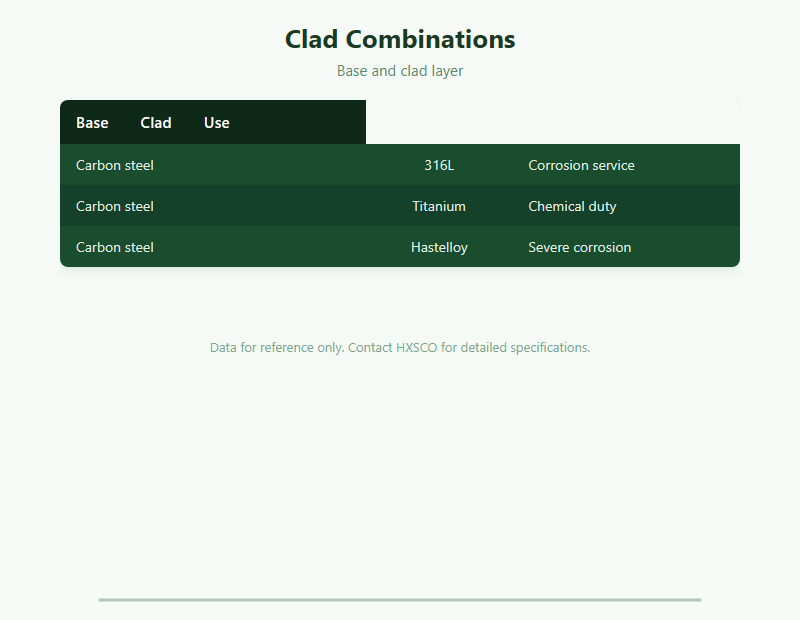
| Base | Clad | Use |
|---|---|---|
| Acciaio al carbonio | 316L | Corrosion service |
| Acciaio al carbonio | Titanio | Chemical duty |
| Acciaio al carbonio | Hastelloy | Severe corrosion |
Where It Is Used
Clad plate serves reactors, columns, heat exchangers and storage tanks in chemical, marine and oil and gas duty, with the corrosion context in our Metal for Oil and Gas Guide and the marine view in our Metal for Marine Guide.
Welding and Inspection
Welding uses transition or buttering layers and is qualified per procedure; inspection follows our Quality Inspection Guide and the welding basis in our Metal Welding Guide.
Specifying and Sourcing
State base grade, clad alloy, thickness of each layer and total size; plan quantity with our MOQ and Lead Time Guide and price with our Price Quotation Guide.
Get a Quote
Tell HXSCO your requirements and we will respond with a competitive quote and lead time.
Domande frequenti
A bimetal with a strong base and a thin corrosion-resistant surface layer.
Both give a metallurgical bond; explosion suits thick or dissimilar pairs.
Clad gives the same surface at far lower cost for large vessels.
Yes with transition layers and qualified procedures.
Give base, clad, each thickness and total dimensions.
Source Clad Steel Plate
HXSCO supplies explosion-bonded and roll-bonded clad plate with stainless, titanium or nickel clad layers. Send base, clad and thickness for a quote.