


Short answer: Carbon steel is iron plus carbon (with trace manganese/silicon) — cheap, weldable and good for structural and mild-duty parts; alloy steel adds chromium, nickel, molybdenum and similar elements for higher hardenability, strength, toughness and temperature resistance at a higher cost.
At a Glance
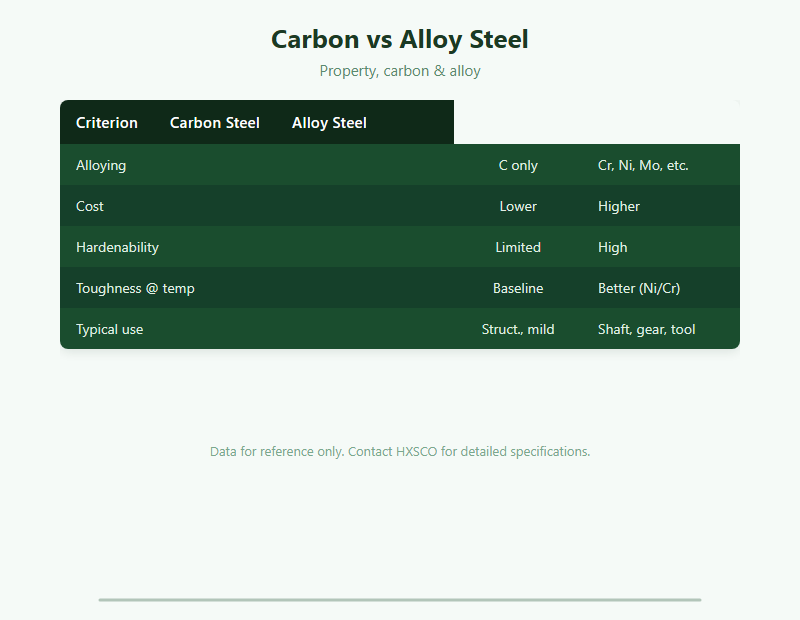
Composition Difference
Carbon steel is defined by its carbon content (low 0.6%) with only minor silicon and manganese. Alloy steel intentionally adds elements — chromium, nickel, molybdenum, vanadium, boron — to tailor properties. The two families anchor our Carbon Steel Supplier e Alloy Steel Supplier programmes; the carbon-level effect is in Low Carbon Vs High Carbon Steel and the grade pair 4140 Vs 1045 Steel.
Properties and Cost
Carbon steel is economical, easy to weld and form, and plenty strong for structures, frames, pipes and general parts. Alloy steel costs more but hardens deeper and more uniformly, holds strength and toughness at low or high temperature, and resists wear and fatigue — why 4140 Vs 4340 Steel e Maraging Steel Guide grades exist for shafts, gears and tools. Heat treatment (see Stress Relieving Vs Annealing) unlocks alloy steel’s potential far more than carbon steel’s.
Choosing by Service
Pick carbon steel for cost-driven, weldable, static or mildly loaded structures and the bulk of piping and plate. Choose alloy steel when hardness, hardenability, impact at temperature, fatigue or wear decide the design — crankshafts, axles, gears, dies, pressure parts. Match the choice to the certificate in Mill Test Certificate Guide and the corrosion plan in Galvanic Corrosion Guide; for the most demanding duty, stainless or nickel alloys take over.
Get a Quote
Tell HXSCO your requirements and we will respond with a competitive quote and lead time.
Domande frequenti
Carbon steel is iron plus carbon; alloy steel adds chromium, nickel, molybdenum and similar elements for higher hardenability, strength, toughness and temperature resistance at higher cost.
Yes, in its heat-treated condition alloy steel is stronger, tougher and more hardenable than carbon steel of similar carbon content, which is why it is used for shafts, gears and tools.
Carbon steel is significantly cheaper and easier to weld and form, making it the default for structural and general-duty parts.
Yes. HXSCO supplies carbon and alloy steel (1045, 4140, 4340 and more) in plate, bar, tube and forgings with mill certificates.
Source Carbon & Alloy Steel from HXSCO
HXSCO supplies carbon and alloy steel in plate, bar, tube and forgings with mill certificates and heat treatment. Send your grade and quantity for a quote.