


Short answer: 304 and 316 are the two most common austenitic stainless steel grades. 304 is lower cost and handles most indoor and food applications. 316 adds molybdenum for superior chloride and marine corrosion resistance. Choose 316 when the environment contains salt, acids, or chlorides.
At a Glance
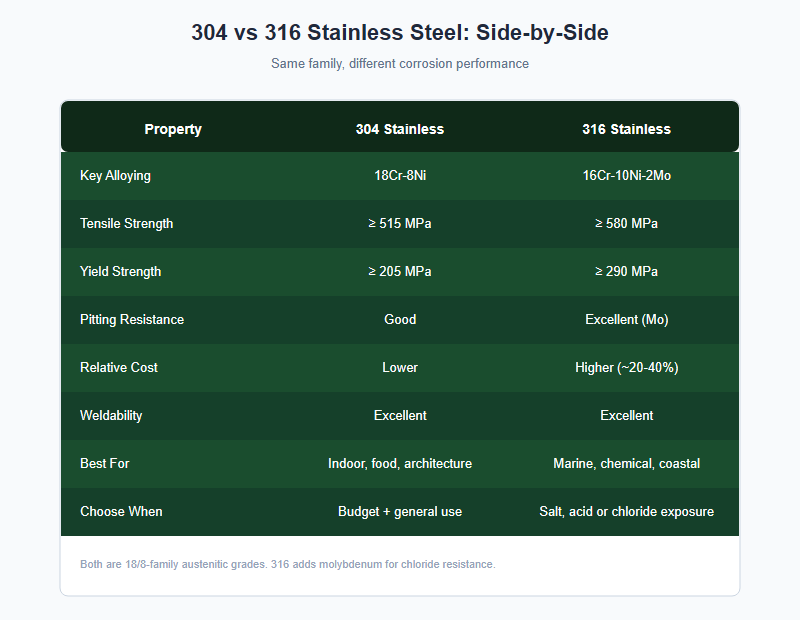
Composition Difference
Both grades belong to the 18/8 austenitic family. 304 contains about 18% chromium and 8% nickel. 316 contains roughly 16% chromium, 10% nickel, and 2–3% molybdenum. That molybdenum is the single biggest reason 316 outperforms 304 in chloride environments.
Resistenza alla corrosione
304 resists most atmospheric, fresh water, food, and mild chemical exposures. 316 resists chlorides, salt spray, seawater, and acidic environments significantly better. If your product will be within 1–2 km of the ocean, used in a swimming pool area, or exposed to road salt or industrial chemicals, 316 is usually the safer choice.
Strength and Cost
316 is slightly stronger than 304 in both tensile and yield strength. It is also 20–40% more expensive on average. For structural designs, the higher strength can sometimes allow slightly thinner sections, but the main reason to pay the premium is corrosion performance.
When to Choose 304
- Indoor equipment, kitchen surfaces, and architectural trim
- Dry or low-chloride environments
- Food processing where salt exposure is limited
- Budget-sensitive projects with adequate corrosion margins
HXSCO supplies 304 piastra in acciaio inox e 304 sheet in a full range of sizes and finishes.
When to Choose 316
- Marine, coastal, and offshore structures
- Chemical and pharmaceutical processing
- Swimming pools and spas
- Applications with regular salt or chloride exposure
For these cases, Piastra in acciaio inox 316 or 316L is usually specified.
Domande frequenti
Yes, if the application involves chlorides, saltwater, or acidic chemicals. For dry indoor use, 304 is usually sufficient and more economical.
Yes, they are both austenitic grades and can be welded together using 308L or 316L filler wire, depending on the corrosion requirements of the joint.
Both are food-safe. 304 is standard for most kitchen and food equipment. 316 is used when equipment is exposed to salt, brine, or aggressive cleaning chemicals.
316 is better for outdoor use near the ocean or in polluted industrial atmospheres. 304 can work in dry urban environments with proper design and maintenance.
A portable XRF analyzer can identify the alloying elements, especially molybdenum in 316. For critical jobs, request a mill-test certificate from your supplier.
Ready to source stainless steel?
Tell us the grade, size, quantity, and destination. HXSCO will reply with a competitive quote, lead time, and mill-test options.
Request a QuoteWhy Buyers Trust HXSCO for Stainless Steel
HXSCO is a stainless steel supplier serving manufacturers, fabricators, and trading companies worldwide. We stock 304, 304L, 316, 316L, 430, 201, and duplex grades in plate, sheet, coil, pipe, tube, and bar forms. Every order can be supplied with mill-test certificates, third-party inspection, and custom cutting/shearing to your drawing. Contact HXSCO for a project-specific quote or material recommendation.