


Short answer: Thermal shock is the cracking or spalling of a metal when a rapid temperature change creates steep internal stresses; resistance improves with low thermal expansion, high conductivity and ductility, so aluminium, copper and refractory metals outperform brittle or high-expansion grades.
At a Glance
Why Metals Crack Under Sudden Heat
A fast temperature change makes the surface and core expand by different amounts, generating stress that exceeds strength — relate to Thermal Expansion Of Metals dan Metal Thermal Conductivity Guide. Repeated cycles also drive Metal Thermal Fatigue Guide dan Metal High Temperature Oxidation Guide.
Ranking the Metals
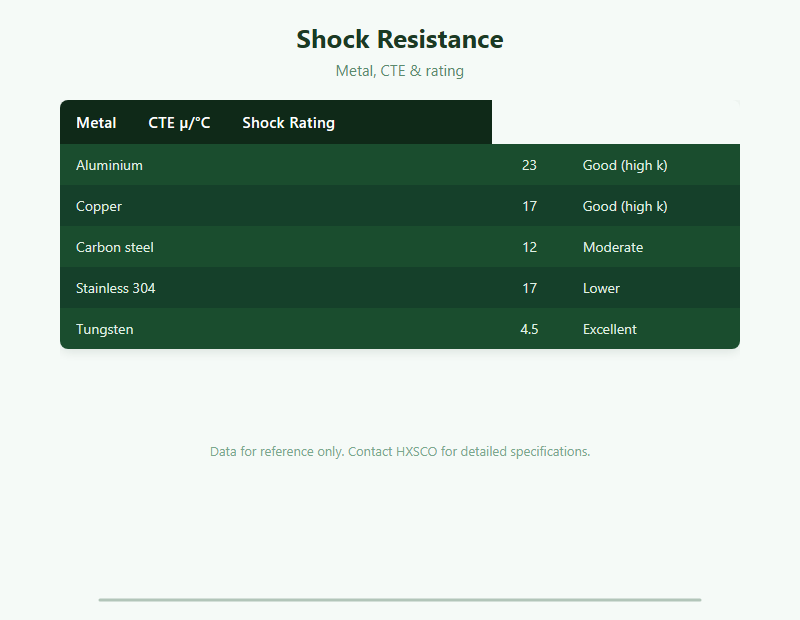
High-conductivity aluminium and copper spread heat fast (low gradient); Tungsten Supplier dan Refractory Metals Supplier have tiny expansion; carbon steel is moderate; austenitic stainless expands more and conducts less, so it is more shock-prone. Tie to Metal Creep Guide for sustained heat.
Design, QA & Supply
Avoid sharp corners (Stress Concentration Guide), pre-heat and control ramp rate; verify with Metal Brittle Fracture Guide checks and Metal Ndt Guide, document per Mill Test Certificate Guide. HXSCO supplies grades matched to your thermal-cycle duty.
Get a Quote
Tell HXSCO your requirements and we will respond with a competitive quote and lead time.
Pertanyaan yang Sering Diajukan
Cracking or spalling of a metal caused by sudden temperature change and the resulting internal stress.
Low-expansion, high-conductivity metals: aluminium, copper, tungsten and refractory alloys.
It has high expansion and lower conductivity, so steep gradients build up under rapid heating/cooling.
Lower ramp rate, avoid stress concentrations, pre-heat and choose a low-CTE alloy.
HXSCO supplies aluminium, copper and refractory-metal grades matched to thermal cycling.
Source Thermal-Cycle Metal from HXSCO
HXSCO supplies aluminium, copper and refractory-metal grades matched to your thermal-shock duty. Send your cycle and quantity for a quote.