



Short answer: Corrosion inhibitors protect metal by forming a protective film or shifting electrochemistry – vapour-phase VCI for packaged and stored parts, anodic and cathodic inhibitors for water and closed loops, and oil or passivating films for bare and stainless surfaces, chosen to match the metal and the environment.
At a Glance
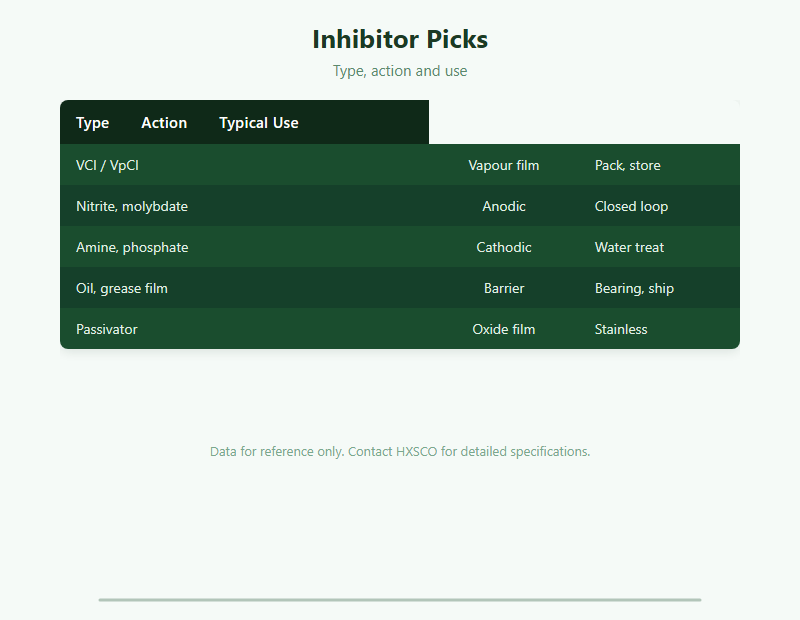
How Inhibitors Work
Inhibitors slow the anodic or cathodic reaction or build a barrier film, with the electrochemistry in our Corrosion Resistance Guide and the protection plan in our Corrosion Protection Guide.
Vapour and Film Types
VCI papers and emitters protect stored parts, while oil and grease films guard machined and shipped surfaces, with finish options in our Surface Treatment Guide dan Electroplating Guide.
Water and Process Loops
Closed heating and cooling loops use nitrite, molybdate or amine inhibitors, with coating backup in our Finishing Coating Guide dan Passivation Guide; galvanic risk is in our Bimetallic Corrosion Guide.
Pairing and Sourcing
Matching inhibitor to metal matters – stainless passivates, steel needs barrier or vapour care, detailed in our Galvanized vs Stainless Guide; buyers confirm grade via our Mill Test Certificate Guide and pack per our Export Packing Guide.
Get a Quote
Tell HXSCO your requirements and we will respond with a competitive quote and lead time.
Pertanyaan yang Sering Diajukan
Vapour-phase corrosion inhibitor that protects enclosed metal parts.
Anodic blocks the metal dissolution; cathodic slows the reduction side.
Nitrite, molybdate or amine inhibitors in treated water.
They passivate, but can need care in chloride or crevice service.
Salt-spray and coupon tests with EN 10204 3.1 certificate.
Source Corrosion-Safe Metal with HXSCO
HXSCO supplies stainless, galvanized and coated steels plus VCI-ready packing for corrosion-sensitive shipments. Send your environment and quantity for a quote.