


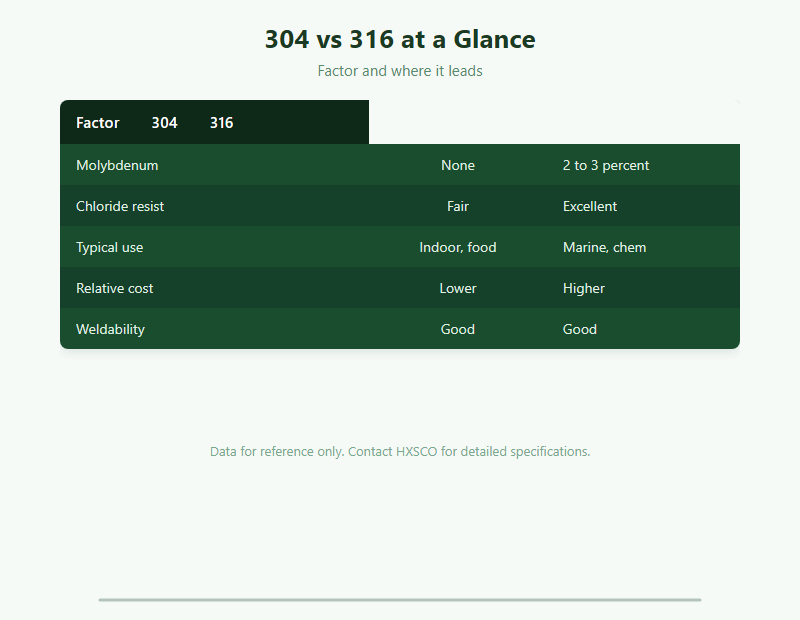
Short answer: Stainless 304 is the general-purpose grade for indoor, food and architectural use at lower cost, while 316 adds 2 to 3 percent molybdenum for strong resistance to chlorides and marine or chemical attack, so 316 is chosen whenever salt, seawater or process chemicals are present and the small cost premium protects the part.
At a Glance
What Sets Them Apart
Molybdenum is the key difference, with resistance detail in our Corrosion Resistance Guide and protection in our Corrosion Protection Guide; the stainless basis is in our Stainless Steel Supplier.
Where Each Belongs
304 suits dry and food duty and 316 suits marine and process duty, with context in our Marine Offshore Guide dan Chemical Processing Guide; galvanic care is in our Bimetallic Corrosion Guide.
Fabrication and Finish
Both weld well and can be passivated for best corrosion life, with welding in our Stainless Welding Guide and finish in our Passivation Guide dan Surface Treatment Guide.
Quality and Sourcing
Stainless is checked by inspection, with methods in our Quality Inspection Guide; buyers confirm grade via our Mill Test Certificate Guide and pack per our Export Packing Guide.
Get a Quote
Tell HXSCO your requirements and we will respond with a competitive quote and lead time.
Pertanyaan yang Sering Diajukan
316 has molybdenum for chloride and marine corrosion resistance.
Yes where salt, seawater or chemicals are present.
Yes – both weld well with proper stainless filler.
316 is the safe choice near the sea.
Mill test certificate shows chemistry and grade.
Specify 304 or 316 with HXSCO
HXSCO supplies 304 and 316 stainless in sheet, plate, bar, tube and pipe. Send grade, finish and quantity for a quote.