


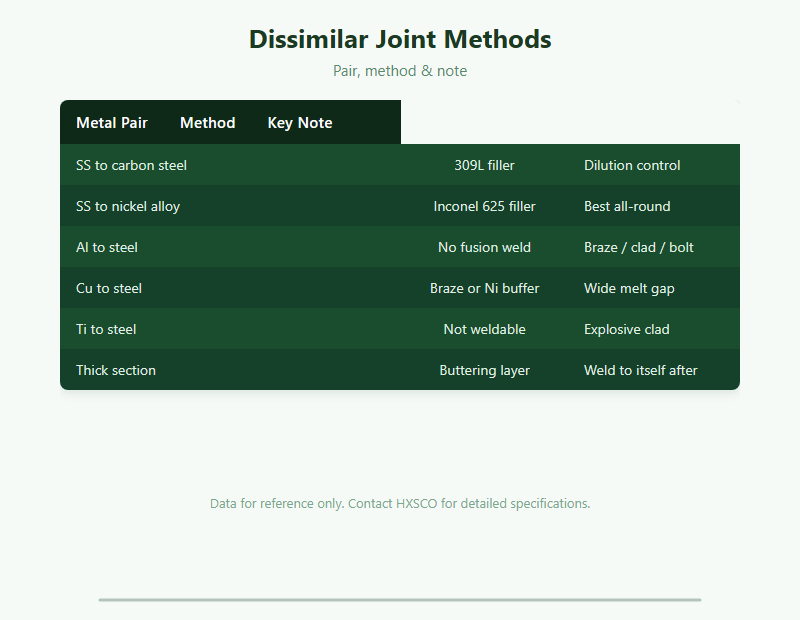
Short answer: Dissimilar metal welding works when the two metals have compatible melting points and form no brittle intermetallics — stainless to carbon steel joins readily with 309L filler, stainless to nickel alloy uses Inconel 625, but aluminium to steel and titanium to steel cannot be fusion welded and need brazing, cladding or mechanical joints.
At a Glance
What Makes a Joint Possible
Four things decide whether two metals can be fusion welded together. Melting point gap — copper melts at 1085 °C against steel’s 1500 °C, so one is liquid while the other is barely warm. Brittle intermetallics — aluminium and iron form Fe-Al phases so brittle the joint fails on cooling, which is the real reason aluminium-to-steel fusion welding does not work. Thermal expansion mismatch loads the joint every thermal cycle, per Thermal Expansion Of Metals. And galvanic coupling means that even a sound joint may corrode fast in service, as Galvanic Corrosion Guide explains.
Joints That Work
Stainless to carbon steel is the everyday dissimilar weld and it is routine with 309L or 309LMo filler, which carries enough extra chromium and nickel to stay austenitic after dilution with the carbon steel. Control dilution by keeping heat input moderate and depositing a buttering layer on the carbon-steel side for thick sections, then welding buttered face to stainless. Practice follows How To Weld Stainless Steel dan How To Weld Carbon Steel, with consumables per Welding Consumables Guide. Watch the carbon-steel side for hydrogen cracking, since it hardens as Steel Carbon Equivalent Guide predicts.
Stainless or carbon steel to nickel alloy is best done with Inconel 625 or 82 filler, which tolerates dilution from both sides and matches the expansion behaviour of neither perfectly but both adequately — see Inconel 600 Vs 625 dan Hastelloy Guide. Duplex to austenitic uses over-alloyed duplex or 309LMo filler and needs tight heat control to hold phase balance, per Duplex Stainless Steel Guide.
When Fusion Is Off the Table
Aluminium to steel dan titanium to steel cannot be fusion welded reliably. The workarounds are real and industrial: explosion-bonded or roll-bonded transition inserts that present each metal its own face, friction or friction-stir welding that stays below melting, brazing with a filler that wets both without alloying deeply per Metal Brazing Vs Soldering, or an honest mechanical joint using Metal Riveting Guide dan Stainless Steel Fasteners Guide with an isolating gasket. Copper to steel is usually brazed or joined through a nickel buffer layer.
Whatever the route, protect the couple afterwards — insulate, coat or cathodically protect per Metal Surface Treatment Guide dan Cathodic Protection Guide — and inspect the transition zone with Metal Ndt Guide, since flaw patterns there differ from those in Weld Defects Guide.
Get a Quote
Tell HXSCO your requirements and we will respond with a competitive quote and lead time.
Pertanyaan yang Sering Diajukan
Yes. Use 309L or 309LMo filler, which stays austenitic after dilution with the carbon steel. Thick sections benefit from a buttering layer on the carbon-steel side.
Not by fusion welding — iron and aluminium form brittle intermetallics that crack on cooling. Use explosion-bonded transition inserts, friction stir welding, brazing or mechanical fasteners.
Inconel 625 or ERNiCr-3 (82) filler is standard, because it tolerates dilution from both sides and resists hot cracking.
They can. Two different metals in electrical contact with an electrolyte form a galvanic cell, so dissimilar joints need coating, insulation or cathodic protection in wet service.
Yes. HXSCO fabricates stainless-to-carbon, stainless-to-nickel and clad transition assemblies with qualified procedures and NDT reports.
Fabricate Dissimilar Joints with HXSCO
HXSCO fabricates stainless-to-carbon, nickel-alloy and clad transition weldments with qualified procedures and NDT. Send your metal pair, service and quantity for a quote.