


Short answer: Laser cladding fuses a powder or wire feed into a thin, metallurgically bonded, low-dilution layer on a metal surface using a focused laser, building up hardfacing, corrosion-resistant or repair deposits with minimal heat and distortion. Unlike thermal spray or electroplating, the clad is fully fused to the substrate, so it survives wear, impact and machining — ideal for rebuilding worn shafts, valve seats and tooling and for surfacing lower-cost base metals with expensive alloys.
At a Glance
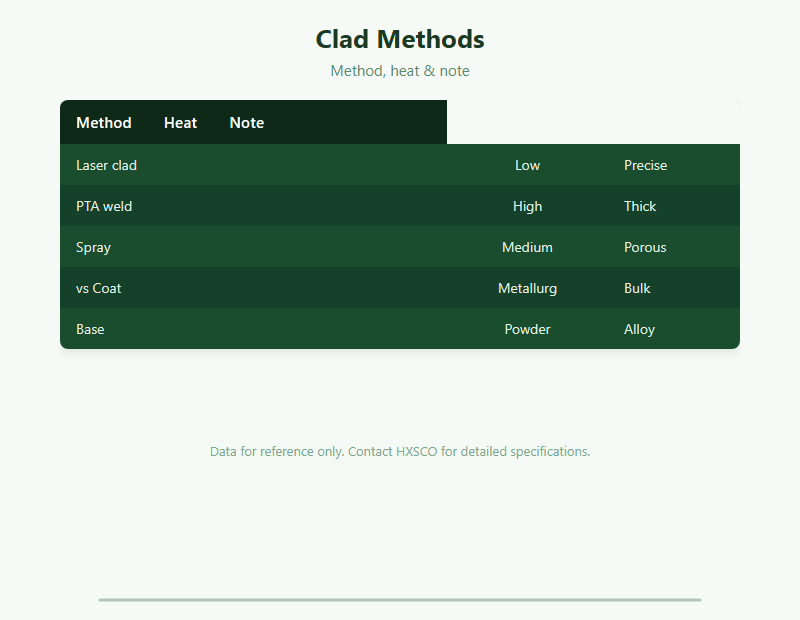
Cladding Methods
Cladding complements Metal Laser Welding Guide et Metal Surface Treatment Guide; relate to Metal Wear Mechanisms Guide et Metal Powder Supplier.
Qualité
Layer bond and dilution checked by Metal Ndt Guide, documented per Mill Test Certificate Guide. Compare Metal Tig Vs Mig Welding Guide.
Supply & QA
Control distortion via Metal Residual Stress Guide; protect via Metal Corrosion Inhibitor Guide et How To Prevent Metal Rust. HXSCO supplies clad powder and base stock.
Get a Quote
Tell HXSCO your requirements and we will respond with a competitive quote and lead time.
Questions fréquemment posées
Laser-fused hardfacing layer with minimal dilution/heat.
Clad is metallurgically bonded; spray is mechanical, porous.
Worn shafts, valve seats, tooling, rolls, dies.
Yes — low heat input, often no post-machining distortion.
HXSCO supplies laser-cladding powders and base alloys.
Source Cladding Powder from HXSCO
HXSCO supplies laser-cladding powders and base metals for hardfacing and repair. Send your alloy and quantity for a quote.