


Short answer: Elastic deformation is reversible spring-back below the yield point while plastic deformation is permanent set above it; the stress-strain curve defines where each begins, and forming, springback and strength are controlled by choosing the right alloy, temper and heat treatment.
At a Glance
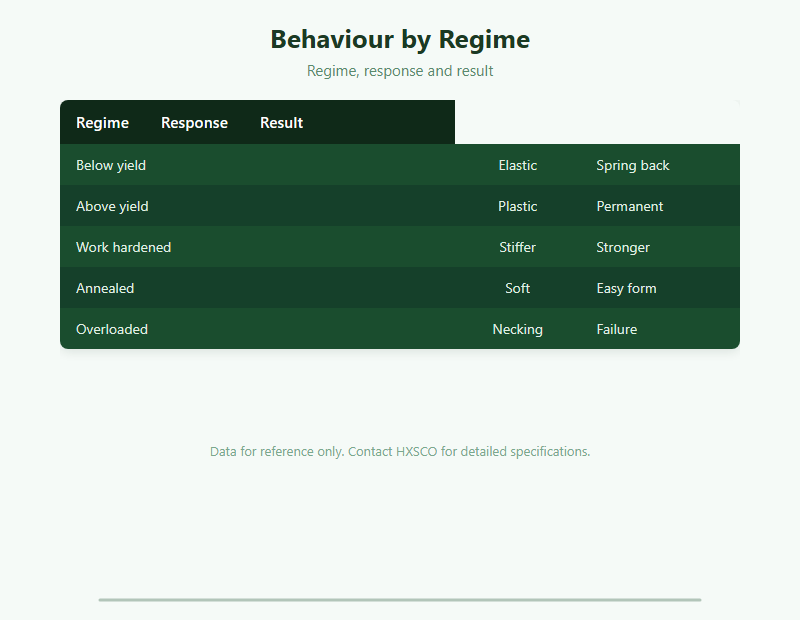
Elastic vs Plastic
Below yield the metal returns to shape; above it the change is permanent, with the strength basis in our Comparaison des forces and hardness in our Hardness Comparison.
The Stress-Strain Curve
The curve shows the elastic slope, yield point and ultimate then failure, with treatment detail in our Heat Treatment Guide and the grade map in our 17-4 PH Stainless page.
Forming and Springback
Higher yield means more springback in bending and stamping, handled in our Stamping Guide et Sheet Fabrication Guide; the alloy logic is in our Aluminum Supplier et Carbon Steel Supplier pages.
Work Hardening and Sourcing
Cold work strengthens by plastic deformation until necking, with inspection in our Quality Inspection Guide; buyers confirm temper and cert via our Mill Test Certificate Guide and pack per our Export Packing Guide.
Get a Quote
Tell HXSCO your requirements and we will respond with a competitive quote and lead time.
Questions fréquemment posées
Reversible shape change that returns when the load is removed, below yield.
Permanent change of shape that remains after the load is removed, above yield.
The elastic part recovers after forming, more so in high-yield metals.
Plastic deformation that makes the metal stronger and harder as it is formed.
Local thinning near failure after the ultimate strength is passed.
Specify Temper with HXSCO
HXSCO supplies annealed, work-hardened and heat-treated metal in the temper and strength your forming and springback needs require, with full certificate. Send your spec for a quote.