


Short answer: Carbon steel is iron with up to about 2.1% carbon and small amounts of manganese and silicon – the workhorse of industry. HXSCO supplies low, medium, and high-carbon grades in plate, sheet, coil, pipe, and bar, with mill-test certificates for structural, automotive, pressure-vessel, and machinery applications.
At a Glance
What Is Carbon Steel?
Carbon steel is defined by its carbon content rather than major alloying elements. More carbon means higher strength and hardness but lower ductility and weldability. With no large chromium or nickel content, it is inexpensive and recyclable, which is why it underpins construction, transport, and manufacturing worldwide.
Grades and Classes at a Glance
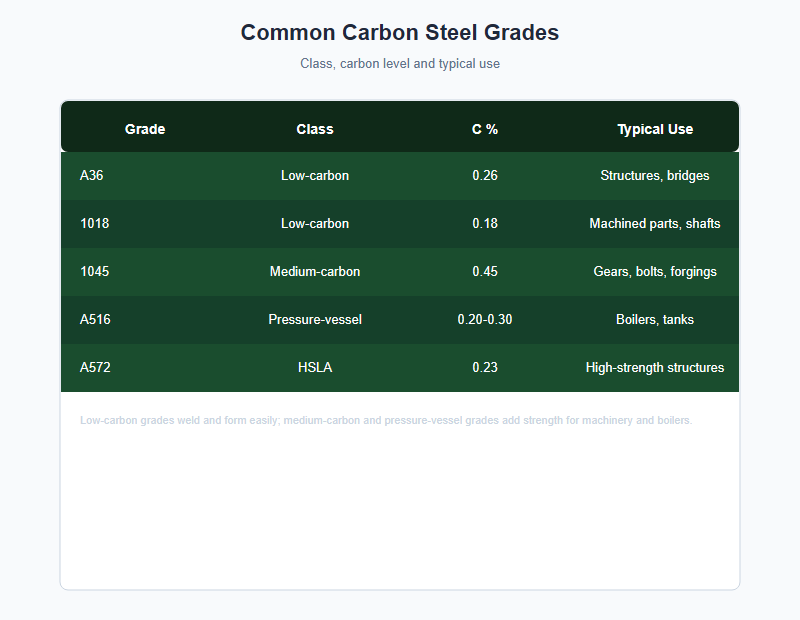
The chart groups the grades buyers specify most. Low-carbon (A36, 1018) is easy to weld and form for structures. Medium-carbon (1045) balances strength and machinability for shafts and gears. High-carbon y pressure-vessel grades (A516) serve wear parts and boilers. See our carbon steel range.
Supply Forms
- Plate & sheet: 1.5-200 mm for structures, tanks, and fabrication.
- Coil: for roll-formed and stamped parts.
- Pipe & tube: structural and pressure service (seamless vs welded).
- Bar & rod: for machining, forging, and fasteners.
Aplicaciones típicas
Carbon steel builds bridges, buildings, and ships; forms automotive bodies and chassis; lines pressure vessels and pipelines; and becomes gears, shafts, and tools. Where cost, strength, and weldability dominate, carbon steel is the default choice.
Sourcing Carbon Steel from HXSCO
HXSCO stocks and sources carbon steel across grades and standards. Tell us the grade, form, dimensions, and quantity, and we will quote with full mill-test certification and the delivery schedule your project needs.
Preguntas frecuentes
Iron with up to about 2.1% carbon plus small amounts of manganese and silicon – no major chromium or nickel alloying, which keeps it inexpensive.
Common grades include A36 (structural), 1018 and 1045 (machinery), A516 (pressure vessel), and A572 (high-strength low-alloy).
Low and medium-carbon grades weld readily with standard processes; high-carbon grades need preheat and controlled cooling to avoid cracking.
Plate, sheet, coil, pipe, and bar across low, medium, and high-carbon grades, with mill-test certificates on request.
State the system and grade (e.g. ASTM A36, EN S355, JIS SS400); see our standards guide and ASTM/ASME carbon-steel page for cross-references.
Ready to source Carbon Steel from HXSCO?
Send us the grade, form, dimensions, quantity, and any certification or test requirements. HXSCO replies with a competitive quote, lead time, and mill-test options.
Request a Quote