


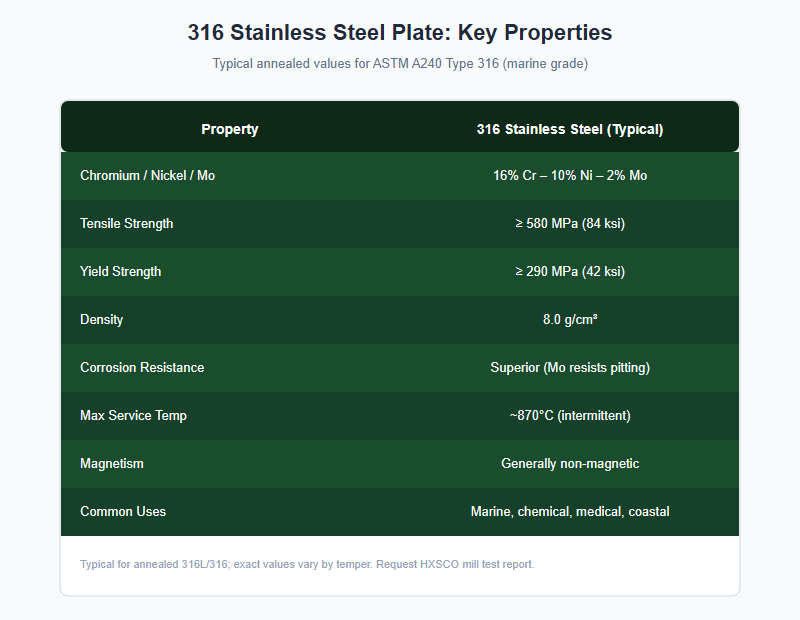
Short answer: 316 stainless steel plate contains 2–3% molybdenum, giving it superior resistance to chlorides, pitting, and crevice corrosion compared with 304. It is the standard choice for marine hardware, coastal architecture, chemical processing, and medical equipment.
At a Glance
What Is 316 Stainless Steel Plate?
316 stainless steel plate is an austenitic chromium-nickel stainless steel with added molybdenum. The molybdenum improves corrosion resistance in chloride and acidic environments, which is why 316 is often called a marine-grade or acid-resistant grade.
Common standards include ASTM A240/A480, EN 10088-2, and JIS G4305. Placa de acero inoxidable 316 is available in hot-rolled No.1 finish, cold-rolled 2B, and polished finishes for visible applications.
Key Properties and Advantages
- Chloride resistance: 2–3% Mo gives excellent resistance to saltwater, brine, and many chemicals.
- Higher strength: Typical tensile and yield strengths are higher than 304.
- Weldability: Good; 316L is preferred for welded structures to avoid carbide precipitation.
- Heat resistance: Maintains oxidation resistance up to about 870 °C intermittent.
316 vs 304: When to Upgrade
If your project is indoors, dry, and not exposed to salt or aggressive chemicals, 304 is usually sufficient and more economical. Choose 316 when the application involves seawater, coastal air, road salt, bleaches, acids, or high humidity with chlorides.
The price premium for 316 over 304 is typically 20–40%, depending on thickness, market conditions, and volume. For long-life marine or chemical equipment, the extra cost is usually recovered through longer service life and lower maintenance.
Applications of 316 Plate
- Marine decks, rails, fittings, and boat hull structures
- Chemical and petrochemical tanks and reactors
- Pharmaceutical and biotech equipment
- Coastal architecture and swimming-pool enclosures
- Pulp and paper processing equipment
Ordering 316 Plate from HXSCO
HXSCO stocks Placa de acero inoxidable 316 y 316 sheet in common thicknesses from 0.5 mm to 100 mm. We can supply 316L, cut-to-size pieces, laser-cut blanks, and polished finishes. Mill-test certificates and third-party inspection are available on request.
Preguntas frecuentes
For chloride-rich or marine environments, yes. 316 contains molybdenum, which gives it better resistance to pitting and crevice corrosion than 304.
Yes, 316 and especially 316L are commonly used for marine fittings, boat rails, and coastal structures. For continuous immersion in warm seawater, higher alloys or duplex grades may be considered.
316L has a lower carbon content, which reduces the risk of chromium carbide precipitation during welding. It is preferred for welded fabrications.
Annealed 316 is generally non-magnetic. Cold working can introduce a small amount of martensite and slight magnetism.
Marine, chemical processing, pharmaceuticals, food and beverage, pulp and paper, and coastal architecture are the largest users.
Ready to source stainless steel?
Tell us the grade, size, quantity, and destination. HXSCO will reply with a competitive quote, lead time, and mill-test options.
Request a QuoteWhy Buyers Trust HXSCO for Stainless Steel
HXSCO is a stainless steel supplier serving manufacturers, fabricators, and trading companies worldwide. We stock 304, 304L, 316, 316L, 430, 201, and duplex grades in plate, sheet, coil, pipe, tube, and bar forms. Every order can be supplied with mill-test certificates, third-party inspection, and custom cutting/shearing to your drawing. Contact HXSCO for a project-specific quote or material recommendation.