


Short answer: Microalloying adds tiny amounts of niobium, vanadium, titanium or boron to steel to refine grains and precipitate hard particles — giving high strength and toughness without the cost or weld problems of heavy quenching and tempering.
At a Glance
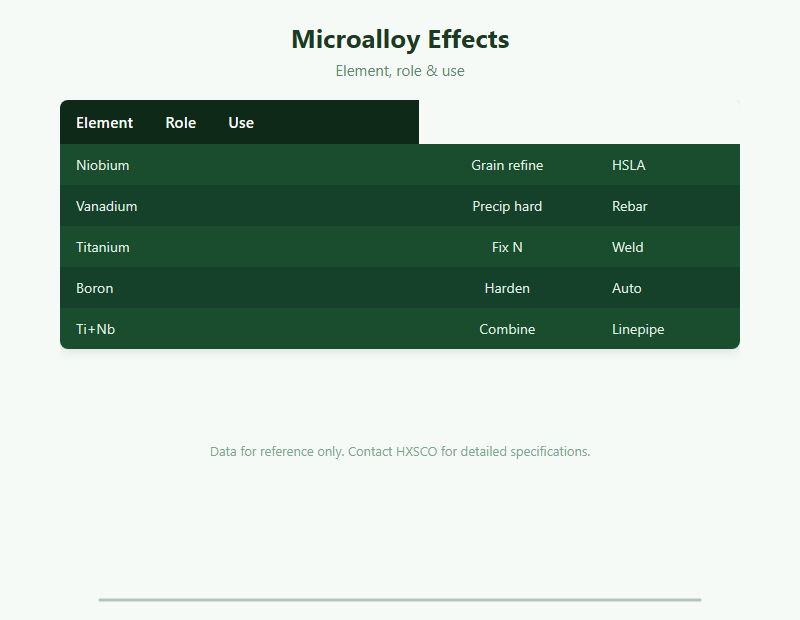
Small Addition, Big Effect
Nb pins grain boundaries (see Metal Grain Size Guide), V precipitates carbides, Ti fixes nitrogen; context in Hsla Steel Guide, Steel Rebar Guide y Boron Steel Guide.
Controlling It
Balance with Metal Recrystallization Temperature Guide y Metal Strain Hardening Guide; inspect via Metal Ndt Guide and document per Mill Test Certificate Guide.
QA & Supply
Protect via How To Prevent Metal Rust. HXSCO supplies microalloyed grades for linepipe, rebar and automotive use.
Get a Quote
Tell HXSCO your requirements and we will respond with a competitive quote and lead time.
Preguntas frecuentes
Adding very small amounts of Nb/V/Ti/B to strengthen steel via grain refinement and precipitation.
It refines grains and raises strength while keeping weldability.
It precipitates carbides for precipitation hardening in rebar and forgings.
Lower carbon avoids the hard zones of quenched-and-tempered steel.
HXSCO supplies Nb/V/Ti/B grades for linepipe, rebar and automotive duty.
Source Microalloyed Steel from HXSCO
HXSCO supplies microalloyed HSLA grades for linepipe, rebar and automotive use with certificates. Send your grade and quantity for a quote.