


Short answer: Galvanic corrosion occurs when two dissimilar metals touch in an electrolyte and the more active one corrodes; control it by choosing close galvanic-series partners, keeping the noble metal area small, insulating the joint, or adding a sacrificial anode and protective coating.
At a Glance
Why Galvanic Couples Form
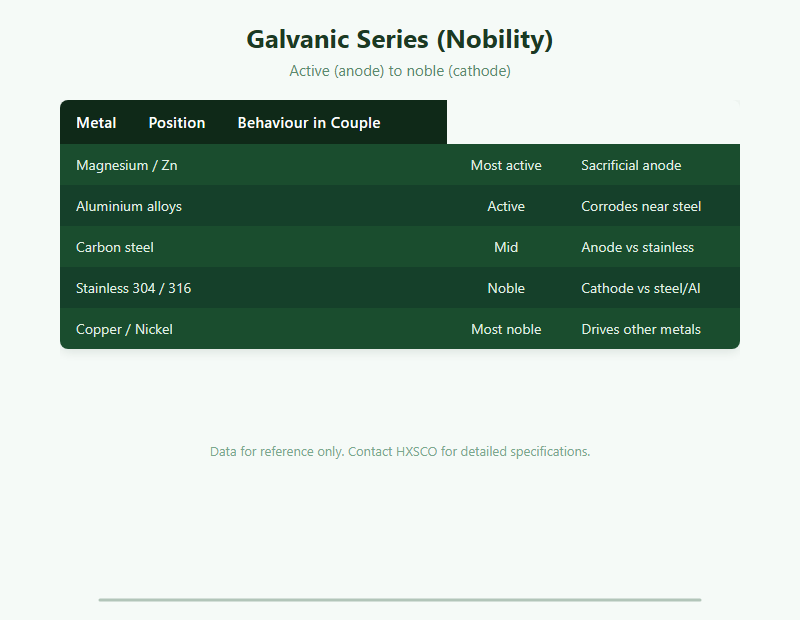
When an active metal (anode) and a noble metal (cathode) connect through an electrolyte, the anode dissolves to protect the cathode. Position in the Steel Grade Chart and alloy selection matter; base metals are reviewed in our Stainless Supplier y Aluminium Supplier guides.
Area Ratio and Risk
A small anode against a large cathode corrodes fast — a thin steel bolt in a big aluminium plate is far riskier than the reverse. Keep the noble-metal area small and the anodic area large, or isolate them. Geometry and fit are part of our Tolerances Fits Guide.
Prevention in Practice
Use insulating washers and gaskets, apply barrier coatings, select close-series partners, or fit a sacrificial zinc or magnesium anode. Coating and surface prep are covered by our Metal Surface Treatment Guide y Electroplating Guide; passivation in our Passivation Guide.
Material Choices
Favour naturally compatible pairs (stainless-to-stainless, aluminium-to-aluminium), and when mixing, specify galvanized steel or coated fasteners so the coating, not the base, sacrifices. Welded transitions are detailed in our Welded Tube Guide.
Get a Quote
Tell HXSCO your requirements and we will respond with a competitive quote and lead time.
Preguntas frecuentes
Two dissimilar metals in an electrolyte — the more active one corrodes as the anode.
The more active (anodic) metal in the galvanic series.
Yes — a small anode with a large cathode corrodes much faster.
Insulate the joint, coat the metals, or add a sacrificial anode.
Only with isolation; stainless is noble and can drive aluminium.
Specify Corrosion-Safe Metal from HXSCO
HXSCO supplies stainless, aluminium, galvanized and coated stock selected to avoid galvanic risk. Send your assembly and environment for a quote.