


Short answer: Grain-oriented electrical steel (GOES / CRGO) has one preferred grain direction, the lowest core loss along that axis, and the highest flux density — ideal for static transformer cores, but it costs more and hums more. Non-grain-oriented electrical steel (NOES / CRNGO) is isotropic, lower cost, and quieter, ideal for rotating motors and generators. Choose GOES for transformers, NOES for rotating machines.
At a Glance
Grain Direction and Magnetism
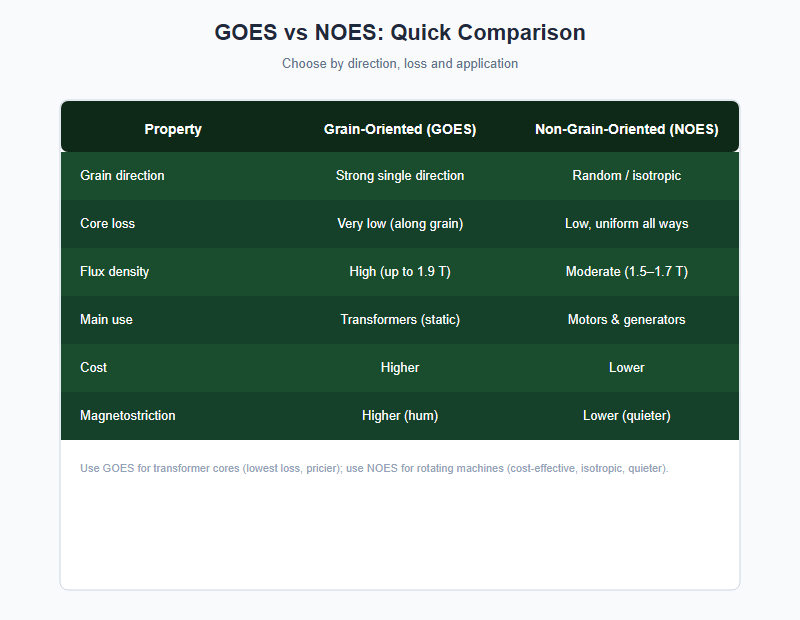
The defining difference is grain structure. GOES aligns nearly all crystals in one direction, so magnetization is easiest — and loss lowest — along that axis. NOES leaves grains random, giving similar magnetic behavior in every direction. That single fact decides the application: static, one-way flux favors GOES; rotating flux favors NOES.
Core Loss and Flux Density
As the chart shows, GOES delivers very low loss (down to ~0.85 W/kg) and high flux density (up to 1.9 T) along the grain, so transformer cores are smaller and cooler. NOES has low but uniform loss in all directions and moderate flux density (1.5–1.7 T). For a motor, NOES wins because GOES would be lossy off-axis.
Cost and Noise
GOES is more expensive to make and tends to higher magnetostriction (transformer hum). NOES is cheaper and quieter, which suits appliances and household motors. Where total cost of ownership is dominated by no-load loss (big transformers), GOES pays for itself; where volume and price dominate (mass-market motors), NOES is the value choice.
How to Choose
- Transformer / reactor / static core: Choose GOES (CRGO), cut along the grain.
- Motor / generator / rotating machine: Choose NOES (CRNGO), isotropic.
- Premium efficiency: Thinner gauges of either type.
- Quiet operation: NOES generally hums less than GOES.
Sourcing Both from HXSCO
HXSCO stocks both types — see our grain-oriented electrical steel y non-grain-oriented electrical steel product pages. Describe your machine (transformer or motor), grade, thickness, and quantity, and we will recommend GOES vs NOES and quote with mill-test certificates.
Preguntas frecuentes
GOES has one preferred grain direction with the lowest loss along it; NOES is isotropic with uniform loss in all directions. GOES suits transformers, NOES suits motors.
GOES (CRGO) is better for transformers because the core flux is static and unidirectional, matching GOES’s low-loss grain direction.
NOES (CRNGO) is better for motors because flux rotates and needs uniform properties in every direction.
Yes. GOES costs more to produce than NOES, but its lower core loss can pay back in transformer lifetime energy savings.
Generally yes — GOES has higher magnetostriction (hum) than NOES, which is one reason NOES is preferred for quiet appliances and motors.
Ready to source electrical steel?
Tell us the type (GOES or NOES), grade, thickness, coating class, width/length, and quantity. HXSCO will reply with a competitive quote, lead time, and mill-test options.
Request a QuoteWhy Transformer & Motor Makers Source Electrical Steel from HXSCO
HXSCO suministra tanto grain-oriented electrical steel (GOES / CRGO) y non-grain-oriented electrical steel (NOES / CRNGO) in coil and sheet for transformer, motor, and generator manufacturers. We stock standard grades (23Q/27Q/30Q GOES, 35W/50W/65W NOES), supply with insulating coating and mill-test certificates, and cut or slit to your lamination width. Contact HXSCO for a project-specific quote or grade recommendation.