


Short answer: Thermal conductivity decides how fast a metal moves heat. Copper and aluminum are excellent conductors for heat exchangers and sinks; stainless steel and titanium are poor conductors suited to retaining or isolating heat. Match the metal to whether you want to spread heat or block it.
At a Glance
Why Conductivity Matters
Thermal conductivity (W/m*K) measures how readily heat flows through a material. High-conductivity metals spread and shed heat; low-conductivity metals hold it. The right choice depends on whether your part is a heat sink, an exchanger, or a thermal barrier.
Conductors vs Insulators
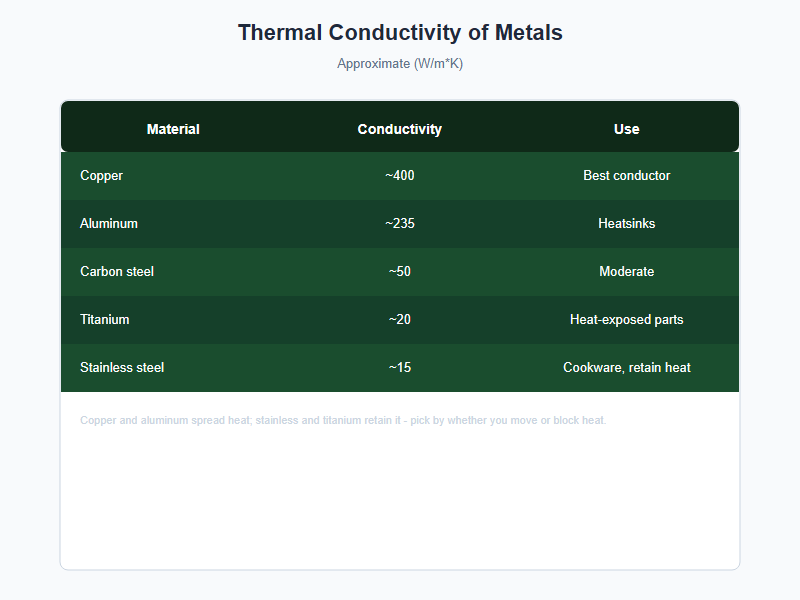
The chart ranks them: copper (~400) und aluminum (~235) are top conductors for sinks and exchangers; carbon steel (~50), stainless (~15)und titanium (~20) are poor conductors used where heat must be contained or where strength/ corrosion lead. See copper und aluminum supply.
Picking the Right Metal
For heatsinks, busbars, and exchangers choose copper or aluminum. For cookware, exhaust, or corrosive heat duty choose stainless. For lightweight high-strength heat-exposed parts choose titanium. Tell HXSCO the thermal duty and we will recommend the alloy.
Häufig gestellte Fragen
Copper is the best common metal conductor (~400 W/m*K), followed by aluminum (~235 W/m*K).
Its alloying and structure give it low thermal conductivity (~15 W/m*K), which is why it is used for cookware and heat-retaining parts.
Yes – aluminum’s high conductivity and low weight make it the standard for heatsinks and exchangers.
Copper and aluminum lead for efficiency; stainless is used where corrosion or pressure dominates over pure conductivity.
No – titanium is a poor conductor (~20 W/m*K) but is chosen for strength and corrosion at temperature.
Ready to source Thermal Conductivity of Metals from HXSCO?
Send us the grade, form, dimensions, quantity, and any certification or test requirements. HXSCO replies with a competitive quote, lead time, and mill-test options.
Request a Quote