



Short answer: Quenching and tempering austenitizes steel, quenches it to hard martensite and tempers it to recover toughness, the core route for shafts and tools arranged via our Heat Treatment Supplier page and the grade choice in our Tool Steel Buyers Guide.
At a Glance
Austenitize and Quench
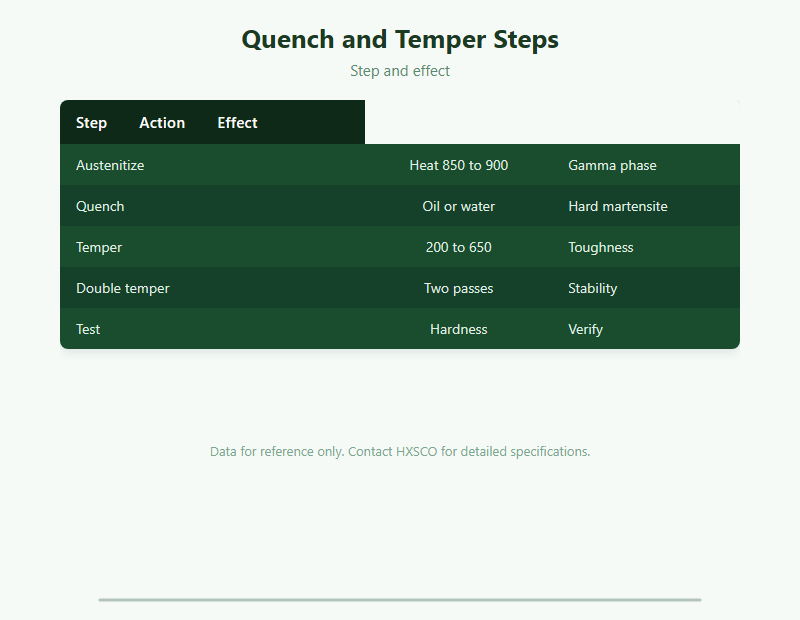
Heating to 850 to 900 C then fast cooling locks a hard martensitic structure, with the steel basis in our Carbon Steel Supplier and the property view in our Hardness and Tensile Guide.
Tempering for Toughness
A 200 to 650 C temper trades a little hardness for ductility and dimensional stability; double tempering improves consistency for critical parts, arranged via our Heat Treatment Supplier page.
Applications and Quality
Shafts, tools and structural fittings rely on quench and temper; verify with our Quality Inspection Guide and documents per our Mill Test Certificate Guide.
Get a Quote
Tell HXSCO your requirements and we will respond with a competitive quote and lead time.
Häufig gestellte Fragen
Yes – both are required.
Oil for alloy, water for shallow.
Adds toughness and stability.
Yes – for critical parts.
Yes – hardness report and MTC.
Get a Quench and Temper Quote
HXSCO arranges quench and temper for carbon, alloy and tool steels with hardness reports. Send grade, size and target hardness for a quote.