


Short answer: Investment casting (lost-wax casting) builds a ceramic shell around a wax pattern, melts the wax out, and pours molten metal into the cavity to make near-net-shape parts with tight tolerances, thin walls and excellent surface finish that are impossible or uneconomic by sand or die casting. It suits stainless, carbon and alloy steel, aluminium, bronze and superalloys for valves, pump bodies, turbine blades, medical and aerospace components in low-to-medium volumes.
At a Glance
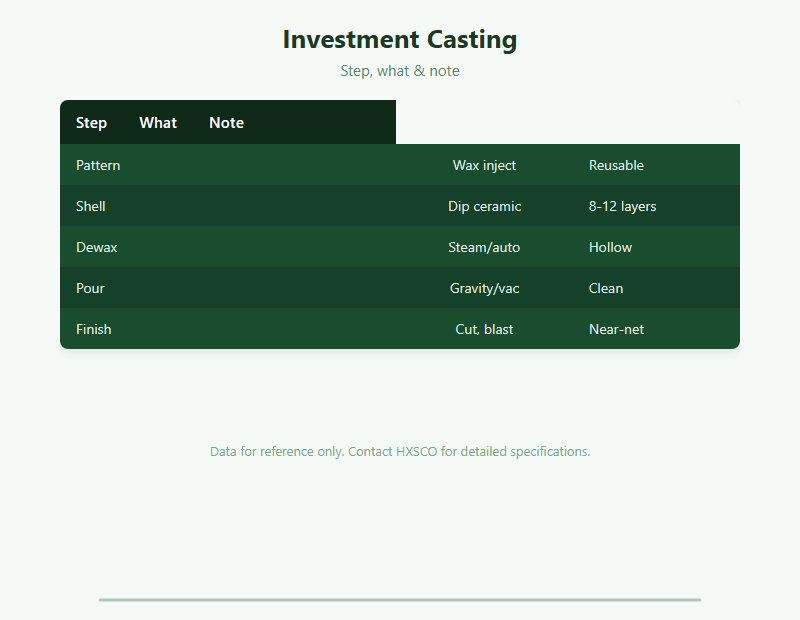
Process & Tolerances
Relate to Casting Supplier, Metal Sand Casting Guide, Metal Permanent Mold Casting Guide und Metal Die Casting Guide; compare Aluminum Die Casting Guide.
Qualität
Internal soundness checked by Metal Ndt Guide, certified by Mill Test Certificate Guide. Relate to Metal Cast Iron Guide.
Supply & QA
Design for feed via Metal Powder Metallurgy Guide; protect via How To Prevent Metal Rust. HXSCO supplies casting-grade melt stock.
Get a Quote
Tell HXSCO your requirements and we will respond with a competitive quote and lead time.
Häufig gestellte Fragen
Lost-wax casting: a ceramic shell replaces a wax pattern, then metal is poured in.
Typically CT5–CT7 (±0.1–0.3 mm) with good surface finish.
Stainless, carbon/alloy steel, aluminium, bronze and superalloys.
For thin walls, fine detail and near-net shape in low/medium volumes.
HXSCO supplies steel, aluminium and bronze melt stock for clean castings.
Source Casting-Grade Metal from HXSCO
HXSCO supplies stainless, aluminium and bronze casting-grade melt stock for low-defect investment castings. Send your alloy and quantity for a quote.