


Short answer: Diffusion bonding joins metals in the solid state by holding clean, pressed surfaces at high temperature so atoms inter diffuse across the interface; it makes strong, near-parent-metal joints with no filler, ideal for dissimilar alloys, thin sections and heat-sensitive parts.
At a Glance
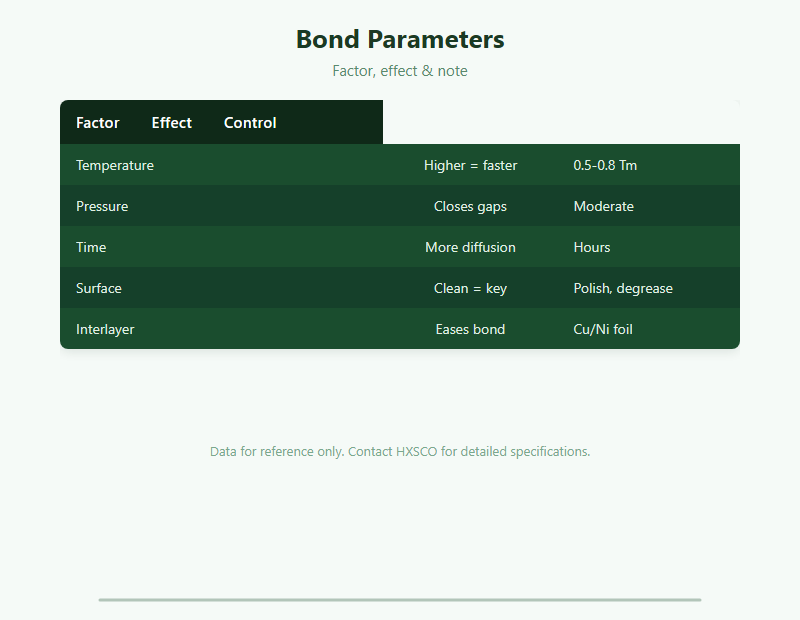
How Diffusion Bonding Works
Under heat (about half the melting point) and modest pressure, surface asperities yield and atoms migrate across the contact, healing voids into a monolithic bond. It is a solid-state cousin of Metal Adhesive Bonding Guide und Metal Brazing Vs Soldering, and avoids the distortion of Wie man Aluminium schweißt und How To Weld Stainless Steel. Good surfaces come from Metal Degreasing Guide und Surface Roughness Ra Guide.
What It Joins Well
Titanium (Titanium Supplier), aluminium (Aluminum Supplier), superalloys (Nickel Alloy Supplier), refractory metals (Refractory Metals Supplier) and dissimilar stacks that are hard to weld via Dissimilar Metal Welding Guide. Interlayers of copper or nickel ease bonding; relate to Metal Tolerances Fits Guide for fit.
Design, QA & Supply
Plan flat, clean interfaces and an interlayer where needed; verify the bond with Metal Ndt Guide (UT) and Tensile Test Guide, and certificate per Mill Test Certificate Guide. HXSCO supplies clean, flat stock and can advise on bond-ready preparation.
Get a Quote
Tell HXSCO your requirements and we will respond with a competitive quote and lead time.
Häufig gestellte Fragen
A solid-state joining process where clean, pressed surfaces held at high temperature let atoms inter-diffuse, forming a monolithic bond with no filler metal.
For dissimilar or heat-sensitive alloys, thin sections and joints where you want no filler and minimal distortion.
Roughly 0.5-0.8 of the absolute melting temperature, with pressure and time tuned to the metal.
Usually no; an interlayer of copper or nickel foil is sometimes added to speed bonding of difficult pairs.
HXSCO supplies clean, flat, tightly-toleranced stock suited to diffusion bonding, with surface records on request.
Source Bond-Ready Metal from HXSCO
HXSCO supplies clean, flat, tightly-toleranced stock suited to diffusion bonding, with surface records on request. Send your alloy, gauge and quantity for a quote.