


Short answer: Copper conducts about 60% better than aluminum by cross-section, creeps less, and joins more reliably, but costs more and is heavier. Aluminum is about one-third the weight and price, ideal for long spans and budget runs where size is not constrained. Choose copper for compact, high-reliability joints; choose aluminum where weight and cost dominate.
At a Glance
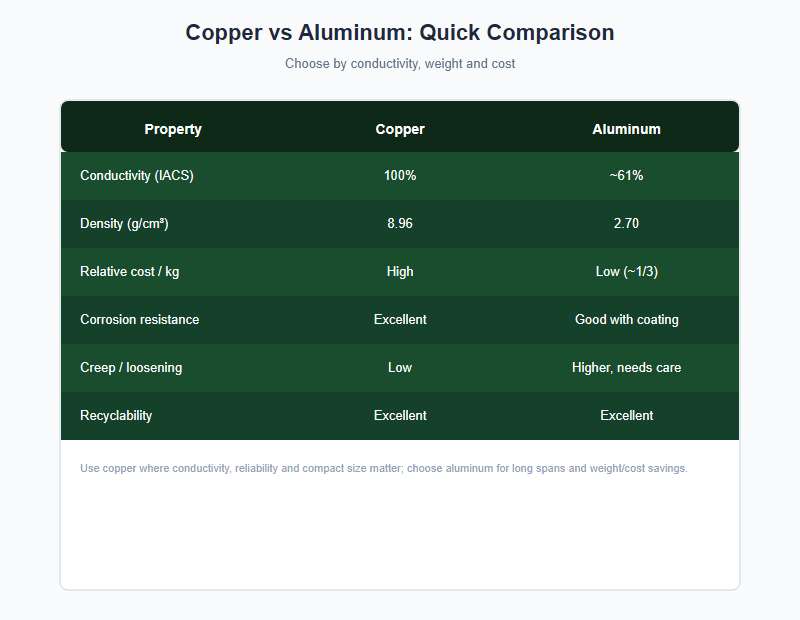
Conductivity and Size
Copper is the reference at 100% IACS conductivity; aluminum is about 61%. To carry the same current, an aluminum conductor needs roughly 1.6× the cross-section of copper. Where space and termination reliability matter, copper wins; where a larger cross-section is acceptable, aluminum is attractive.
Weight and Cost
As the chart shows, aluminum is far lighter (2.70 vs 8.96 g/cm³) and usually about one-third the price per kilogram. For long overhead spans, busbars, and budget-sensitive distribution, that weight and cost saving is decisive. Copper’s higher density and price are the trade-off for its performance.
Corrosion and Joints
Copper resists corrosion and creeps little, so properly made joints stay tight. Aluminum forms an insulating oxide and creeps under load, so it needs antioxidant paste, proper torque, and often bi-metallic lugs where it meets copper. Get the termination right and aluminum performs well.
When to Choose Which
- Choose copper for compact switchgear, reliable terminations, grounding, and where space is tight.
- Choose aluminum for overhead lines, long busbars, and cost/weight-sensitive distribution where size is not a constraint.
- Hybrid: Use copper terminations on aluminum conductors via bi-metallic lugs.
Sourcing Conductors from HXSCO
HXSCO supplies copper sheet, bar, rod, and wire, and related copper-alloy products — see our Lieferanten von Messingstangen page. Kontakt with your current rating, environment, and budget, and we will recommend copper vs aluminum and quote the right form.
Häufig gestellte Fragen
Copper conducts better, creeps less, and makes more reliable joints, so it is preferred for most building and equipment wiring where size and reliability matter.
Aluminum is about one-third the weight and cost, ideal for long spans and budget runs where a larger conductor cross-section is acceptable.
Copper is about 100% IACS; aluminum is about 61%, so aluminum needs roughly 1.6× the cross-section for the same current.
Yes, but use bi-metallic (transition) lugs and antioxidant paste to avoid galvanic corrosion and loose joints at the copper-aluminum interface.
Per kilogram, aluminum is typically around one-third the cost of copper, though you need a larger cross-section to carry the same current.
Ready to source copper or copper alloys?
Tell us the grade (C11000, C12200, brass, etc.), form, size, quantity, and destination. HXSCO will reply with a competitive quote, lead time, and mill-test options.
Request a QuoteWhy Buyers Source Copper & Copper Alloys from HXSCO
HXSCO supplies copper and copper-alloy long products and fabricated parts to manufacturers, electrical contractors, and trading companies worldwide. We stock ETP (C11000), oxygen-free (C10200), and DHP (C12200) copper plus brass and bronze alloys in sheet, plate, pipe, tube, bar, rod, and wire. Material can be supplied with mill-test certificates, precision cutting, and export packing. Contact HXSCO for a project-specific quote or grade recommendation.