


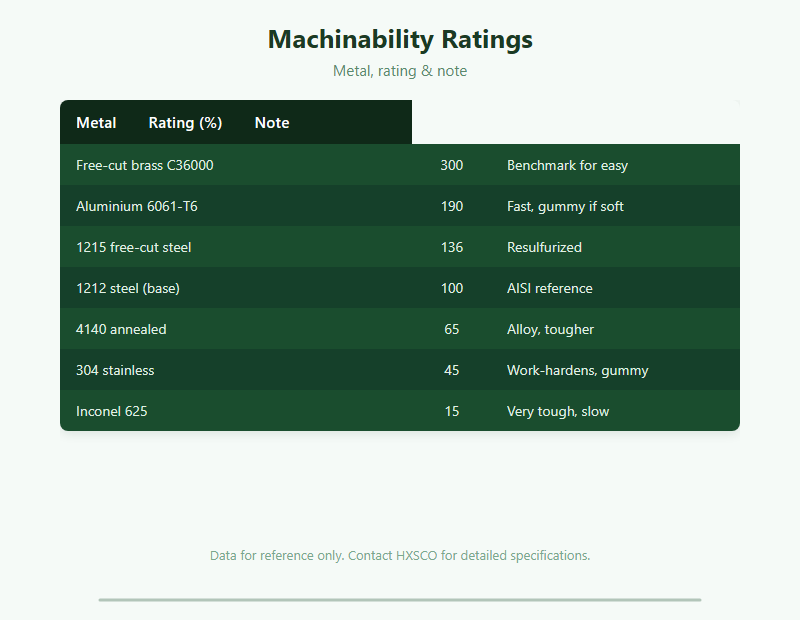
Short answer: Machinability rating compares how easily a metal cuts against AISI 1212 steel at 100 — free-cutting brass reaches 300 and aluminium 190, while 304 stainless drops to 45 and Inconel to 15, so speeds, feeds, tooling and price all follow the number.
At a Glance
What the Rating Means
Machinability rating expresses relative cutting ease against AISI 1212 free-machining steel, fixed at 100. It bundles four separate things that a single number hides: achievable cutting speed for a given tool life, cutting force and power, chip form, and attainable surface finish. Treat it as a planning shortcut, not a physical constant, because two grades with the same rating can behave very differently on the machine.
Free-cutting brass C36000 tops the scale near 300 because lead or bismuth breaks chips cleanly — see Brass Grades Guide ve Brass Supplier. Aluminium 6061-T6 rates about 190 and cuts fast, though soft tempers smear; grade data is in Aluminum 6061 Properties.
Why Some Metals Fight Back
Austenitic stainless rates around 45 for two linked reasons: it work-hardens rapidly under the tool, so a rubbing or dwelling cutter glazes the surface into something even harder, and it conducts heat poorly, so heat concentrates at the edge instead of leaving in the chip. The fix is a positive rake, sharp tooling, rigid setup and a steady feed that never dwells — the practical detail is in How To Cut Stainless Steel and the grade families in Paslanmaz Çelik Sınıfları Açıklandı ve Ferritic Vs Austenitic Stainless.
Nickel alloys per Inconel 600 Vs 625 ve Hastelloy Guide take this further, sitting near 15 with severe work-hardening and abrasive carbides. Hardened tool steel and Wear Resistant Steel Supplier plate resist cutting by design, so grinding, EDM or Laser Vs Plasma Cutting often replaces milling. At the other extreme, titanium’s low rating is less about hardness than heat and chemical reactivity — see Titanium Grade 2 Vs 5.
Improving Machinability
Condition beats grade more often than people expect. Annealed 4140 rates about 65 but hardened 4140 is far worse, so machine before heat treatment wherever the tolerance allows — see Metal Heat Treatment Guide ve Annealing Vs Normalizing. Cold-drawn bar cuts more predictably than hot-rolled because of a cleaner surface and more uniform structure, per Cold Rolling Vs Hot Rolling. Where volume is high, near-net-shape routes remove the problem entirely: Metal Stamping Vs Machining, Casting Supplier, Forging Supplier ve Metal Injection Molding Guide all cut the metal you never have to machine.
Finish expectations should be set with Surface Roughness Ra Guide and hardness verified per Metal Hardness Testing Methods. Our Cnc Machining Supplier programme machines all these families to drawing.
Get a Quote
Tell HXSCO your requirements and we will respond with a competitive quote and lead time.
Sıkça Sorulan Sorular
Machinability rating compares how easily a metal cuts relative to AISI 1212 free-machining steel, which is set at 100. Higher is easier to machine.
Free-cutting brass C36000 at about 300, followed by aluminium 6061 near 190 and resulfurized free-cutting steels around 136.
Austenitic stainless work-hardens rapidly under the tool and conducts heat poorly, so heat stays at the cutting edge. It needs sharp positive-rake tooling, rigid setup and a steady feed with no dwelling.
Machine before hardening wherever tolerances allow, since annealed steel cuts far more easily. Finish grinding after heat treatment holds the final dimension.
Yes. HXSCO machines stainless, duplex, nickel alloys, titanium and tool steel to drawing with measured finish and hardness reports.
Machine Difficult Alloys with HXSCO
HXSCO machines stainless, duplex, nickel alloy, titanium and tool steel to your drawing with finish and hardness reports. Send your part and quantity for a quote.