


Short answer: Electrical steel is a low-carbon silicon alloy engineered for low core loss in magnetic circuits; grain-oriented grades serve transformers and non-oriented grades serve motors and generators, supplied from the alloy basis in our Alloy Steel Supplier page and the procurement route in our Import Steel from China Guide.
At a Glance
What Electrical Steel Is
Electrical steel (silicon steel) is a low-carbon alloy with 0.5 to 3.0 percent silicon that lowers core loss and increases electrical resistivity in transformers and rotating machines. The alloy basis is in our Alloy Steel Supplier page.
Grain-Oriented vs Non-Oriented
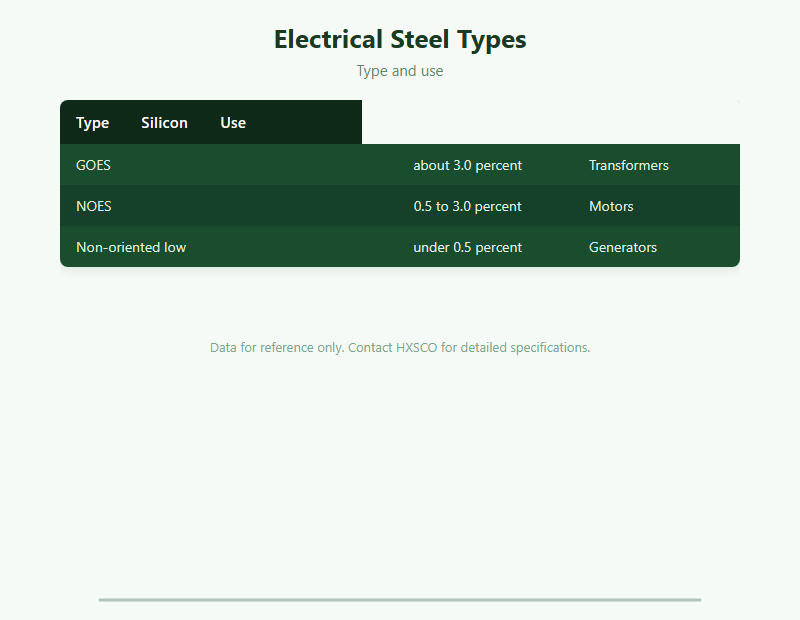
Grain-oriented electrical steel (GOES) has magnetic properties aligned to one direction for efficient transformer cores. Non-oriented electrical steel (NOES) has uniform properties in the plane for motors and generators.
| Tip | Silikon | Use |
|---|---|---|
| GOES | about 3.0 percent | Transformers |
| NOES | 0.5 to 3.0 percent | Motorlar |
| Non-oriented low | under 0.5 percent | Jeneratörler |
Key Properties to Specify
Buyers focus on core loss (W/kg at a given frequency and flux density), permeability and lamination thickness. Verification is in our Quality Inspection Guide and the document detail in our Mill Test Certificate Guide.
Forms and Supply
Electrical steel is supplied as thin laminations or coils; compare stock forms in our Steel Coil Buyers Guide and the energy context in our Metal for EV Guide.
Specifying and Sourcing
State grade (for example M19, M36), thickness and loss target; plan quantity with our MOQ and Lead Time Guide and price with our Price Quotation Guide.
Get a Quote
Tell HXSCO your requirements and we will respond with a competitive quote and lead time.
Sıkça Sorulan Sorular
GOES is directional for transformers, NOES is uniform for motors and generators.
It lowers core loss and resistivity for efficient magnetic cores.
The power lost as heat in the steel during magnetization, in W/kg.
As thin laminations or coils to control eddy currents.
Give grade, thickness and target core loss.
Source Electrical Steel
HXSCO supplies grain-oriented and non-oriented electrical steel with core-loss data. Send grade, thickness and loss target for a quote.