


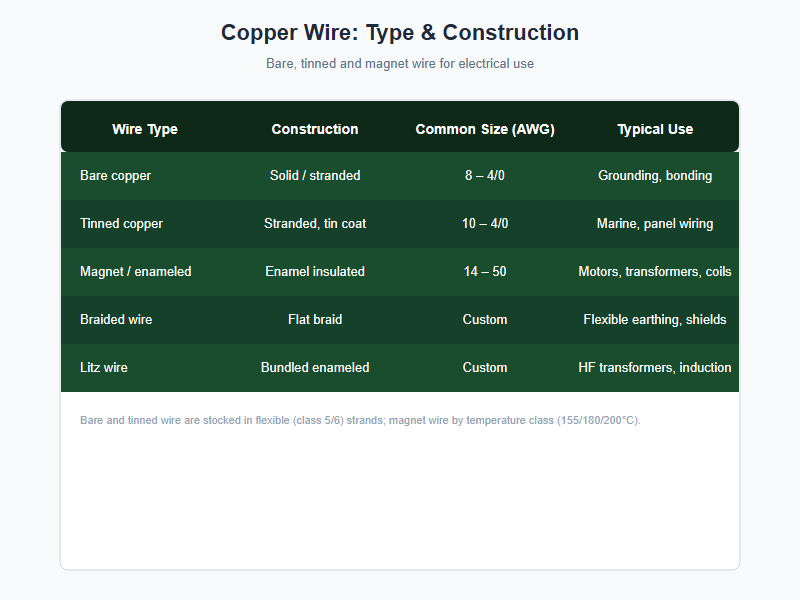
Short answer: Copper wire is the most common electrical conductor. Bare copper is used for grounding and bonding; tinned copper resists corrosion in marine and panel wiring; magnet (enameled) wire winds motors, transformers, and coils. Sizes are given in AWG or mm², and flexible strands suit moving or vibration-prone runs.
At a Glance
Why Copper Wire?
Copper has the best conductivity of any common metal except silver, so copper wire carries more current in a smaller cross-section than aluminum. It is ductile, joins easily, and resists corrosion, which is why it dominates building wire, equipment grounding, and coil winding.
Bare and Tinned Copper Wire
Bare copper is the standard for grounding, bonding, and busbar jumpers, supplied solid or stranded. Tinned copper has a thin tin coating that slows corrosion in humid, marine, and industrial environments and improves solderability. Both are stocked in flexible (class 5/6) strands for panels and switchgear.
Magnet (Enameled) Wire
Magnet wire is copper coated with a thin enamel insulation so many turns can sit side by side without shorting. It winds the coils of motors, transformers, relays, and inductors. It is specified by temperature class (155/180/200°C) and by AWG or mm gauge. Litz wire bundles many enameled strands to reduce high-frequency losses.
Gauges and Stranding
Wire size is given in AWG (North America) or mm² (metric). Larger numbers mean thinner wire. Stranded and braided constructions flex without breaking, which matters for earthing bonds, shields, and moving equipment. Pick the gauge from your current rating and the insulation temperature.
Sourcing Copper Wire from HXSCO
Tell HXSCO the type (bare, tinned, magnet), gauge, strand class, insulation/temperature class, and length or weight. We can also supply copper bar and rod — see our pirinç çubuk tedarikçileri page — and will quote a combined electrical package. Request a quote.
Sıkça Sorulan Sorular
Bare copper is uncoated; tinned copper has a thin tin layer that resists corrosion in marine and humid environments and solders more easily.
Magnet (enameled) wire winds the coils of motors, transformers, relays, and inductors where insulated turns must sit close together.
In AWG (North America) or mm² (metric). Larger AWG numbers mean thinner wire; choose by current rating and temperature class.
Copper conducts about 60% better by cross-section, creeps less, and joins more reliably, so it is preferred for most building and equipment wiring.
Litz wire is many insulated enameled strands bundled to reduce skin effect and losses in high-frequency transformers and induction coils.
Ready to source copper or copper alloys?
Tell us the grade (C11000, C12200, brass, etc.), form, size, quantity, and destination. HXSCO will reply with a competitive quote, lead time, and mill-test options.
Request a QuoteWhy Buyers Source Copper & Copper Alloys from HXSCO
HXSCO supplies copper and copper-alloy long products and fabricated parts to manufacturers, electrical contractors, and trading companies worldwide. We stock ETP (C11000), oxygen-free (C10200), and DHP (C12200) copper plus brass and bronze alloys in sheet, plate, pipe, tube, bar, rod, and wire. Material can be supplied with mill-test certificates, precision cutting, and export packing. Contact HXSCO for a project-specific quote or grade recommendation.