


Short answer: Bearing steel is a high-carbon chromium alloy (typically 52100 or 100Cr6) hardened for high fatigue life in rolling elements, with 440C for corrosive service, based on the alloy content in our Alloy Steel Supplier page and the thermal route in our Heat Treatment Steel Guide.
At a Glance
What Bearing Steel Is
Bearing steel is a high-carbon, chromium-rich alloy made for through-hardening to very high hardness with excellent rolling-contact fatigue life. The alloy basis is in our Alloy Steel Supplier page.
Ortak Notlar
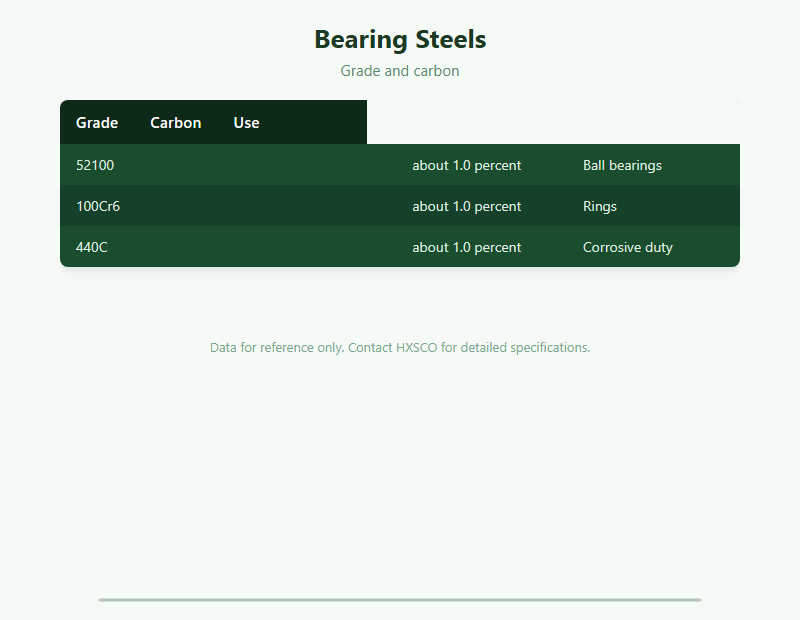
52100 (SAE) and 100Cr6 (EN) are the standard grades for balls and rings; 440C adds corrosion resistance for food, marine and medical duty. The comparison below lists typical carbon levels.
| Sınıf | Karbon | Use |
|---|---|---|
| 52100 | about 1.0 percent | Ball bearings |
| 100Cr6 | about 1.0 percent | Rings |
| 440C | about 1.0 percent | Corrosive duty |
Heat Treatment and Properties
Bearing steel is through-hardened and stress-relieved for hardness near 60 HRC and stable dimensions. The thermal route is in our Heat Treatment Steel Guide and verification in our Quality Inspection Guide.
Forms and Supply
It is supplied as bar, tube and forged rings; compare stock forms in our Steel Bar Buyers Guide and the automotive context in our Metal for EV Guide.
Specifying and Sourcing
State grade, form, size and hardness need; plan quantity with our MOQ and Lead Time Guide and price with our Price Quotation Guide.
Get a Quote
Tell HXSCO your requirements and we will respond with a competitive quote and lead time.
Sıkça Sorulan Sorular
A high-carbon chromium steel through-hardened for fatigue life.
The same steel family under SAE and EN names.
For corrosive or washdown duty where 52100 would rust.
Typically near 60 HRC after through hardening.
Give grade, form, size and hardness requirement.
Source Bearing Steel
HXSCO supplies 52100, 100Cr6 and 440C bearing steel as bar, tube and forged rings. Send grade, form and size for a quote.