


Short answer: A tensile test pulls a machined coupon to failure and records yield strength, tensile strength, elongation and reduction of area — the certified mechanical properties that prove a metal meets its grade on the mill certificate.
At a Glance
The Tensile Test
A round or flat coupon is gripped and pulled at a controlled rate while a extensometer records load versus stretch. The result is the stress-strain curve that defines the metal. It is the backbone of Yield Strength Vs Tensile Strength and the proof behind every Mill Test Certificate Guide.
Reading the Curve
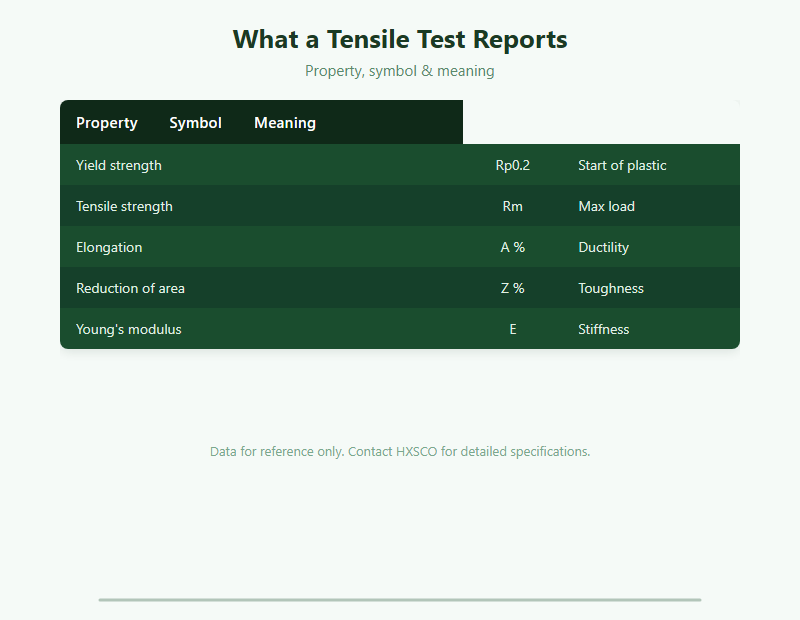
Yield strength (Rp0.2) is where plastic (permanent) deformation begins — the design limit. Tensile strength (Rm) is the peak load before necking. Elongation (A%) e reduction of area (Z%) measure ductility and toughness. Young’s modulus (E) is the elastic stiffness. These are reported beside hardness (see Metal Hardness Testing Methods) and impact (see Charpy Impact Test Guide).
Why It Matters for Sourcing
Buyers specify minimum Rp0.2 and Rm by grade; cross-reference them with Steel Grade Equivalent Chart e Jis Steel Equivalent. A coupon that meets the numbers confirms the heat is correct — so always request the tensile results on the certificate, not just chemistry.
Get a Quote
Tell HXSCO your requirements and we will respond with a competitive quote and lead time.
Perguntas frequentes
A tensile test measures yield strength, tensile strength, elongation and reduction of area by pulling a coupon to failure — the certified mechanical properties of the metal.
Yield strength is where permanent deformation starts (the design limit); tensile strength is the maximum load the metal reaches before it necks and breaks.
Ductility is shown by elongation (A%) and reduction of area (Z%) — higher values mean the metal stretches and deforms more before fracturing.
Yes. HXSCO supplies metal with tensile (yield, tensile, elongation) results on the EN 10204 mill test certificate per order.
Specify Certified Metal from HXSCO
HXSCO supplies carbon, alloy and stainless steel with certified tensile properties on the mill certificate. Send your grade and requirement for a quote.