


Short answer: Transformer cores are built from grain-oriented electrical steel (CRGO / GOES) because its single grain direction gives the lowest core loss at high flux density (up to 1.7–1.9 T). Shell-type and core-type power and distribution transformers use 0.23–0.35 mm GOES cut along the grain; toroidal cores use GOES strip; ultra-low-loss units may use amorphous alloy instead.
At a Glance
Why Transformers Use GOES
A transformer core carries unidirectional, alternating flux, so the material’s easy magnetization axis should line up with the flux path. Grain-oriented electrical steel does exactly that, delivering the lowest possible core loss and hum. NOES would waste performance here because it is optimized for rotating, not static, flux.
Core Types and Steel Choice
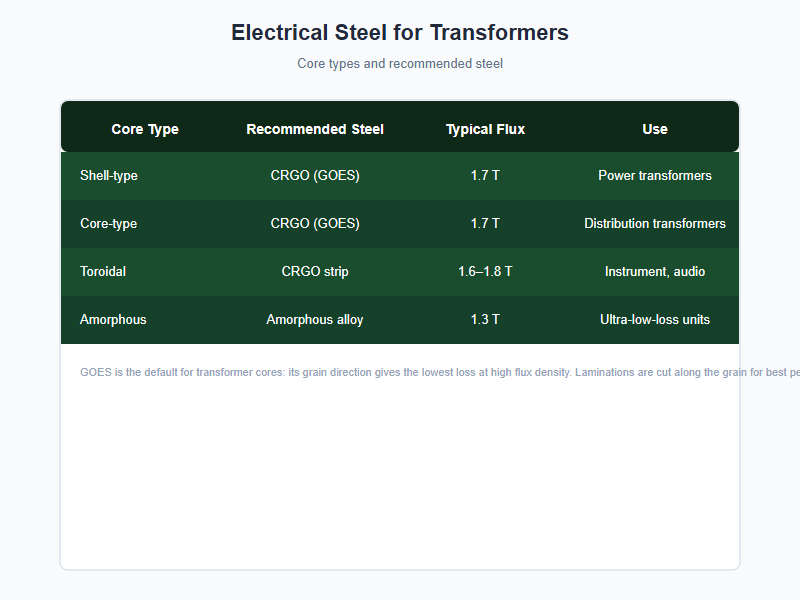
The chart above maps core types to steel. Shell-type e core-type power and distribution transformers use CRGO at about 1.7 T. Toroidal cores are wound from GOES strip at 1.6–1.8 T for instrument and audio use. Amorphous alloy cores trade higher cost for the lowest loss in premium distribution units.
Loss, Flux Density, and Efficiency
Core loss (no-load loss) is the dominant lifetime energy cost of a transformer, so specifying thin GOES (0.23–0.27 mm) pays back through lower losses. Flux density near 1.7 T is standard; pushing higher saves material but raises loss and noise. Balance loss, noise, and size for your duty cycle.
Cutting and Stacking
- Step-lap cores reduce joint flux fringing and loss.
- Laser scribing further lowers loss in premium GOES.
- Coating integrity after cutting keeps inter-laminar resistance high.
- Stacking factor sets the usable steel area of the core.
Sourcing Transformer Steel from HXSCO
HXSCO supplies grain-oriented electrical steel for transformer cores — see our grain-oriented electrical steel product page. Tell us the core type, grade, thickness, coating, and width, and we will slit and quote with mill-test certificates. For motors, also see our non-grain-oriented electrical steel.
Perguntas frequentes
Grain-oriented electrical steel (GOES / CRGO) is used because its single grain direction gives the lowest core loss at high flux density.
Standard transformer cores run about 1.7 T in GOES; toroidal GOES cores may reach 1.6–1.8 T. Amorphous cores use about 1.3 T.
NOES is isotropic and tuned for rotating flux; a transformer’s static, unidirectional flux is better served by directional GOES, which has far lower loss along the grain.
Core (no-load) loss is a continuous energy cost over the transformer’s life, so thinner GOES with lower loss pays back through reduced operating energy.
Large power transformers use 0.23–0.27 mm for minimum loss; distribution transformers use 0.30–0.35 mm to balance cost and performance.
Ready to source electrical steel?
Tell us the type (GOES or NOES), grade, thickness, coating class, width/length, and quantity. HXSCO will reply with a competitive quote, lead time, and mill-test options.
Request a QuoteWhy Transformer & Motor Makers Source Electrical Steel from HXSCO
A HXSCO fornece ambos grain-oriented electrical steel (GOES / CRGO) e non-grain-oriented electrical steel (NOES / CRNGO) in coil and sheet for transformer, motor, and generator manufacturers. We stock standard grades (23Q/27Q/30Q GOES, 35W/50W/65W NOES), supply with insulating coating and mill-test certificates, and cut or slit to your lamination width. Contact HXSCO for a project-specific quote or grade recommendation.