


Short answer: This tungsten buyers guide explains that W1 rod serves electrodes and balancing, fine wire serves filaments and EDM, tungsten carbide serves cutting tools, and W-Ni-Fe heavy alloy serves counterweights, with demand driven by tungsten’s highest melting point and extreme density; buyers should confirm form, binder content and certificate, and match grade to tooling, shielding or weight use with our refractory and carbide knowledge.
At a Glance
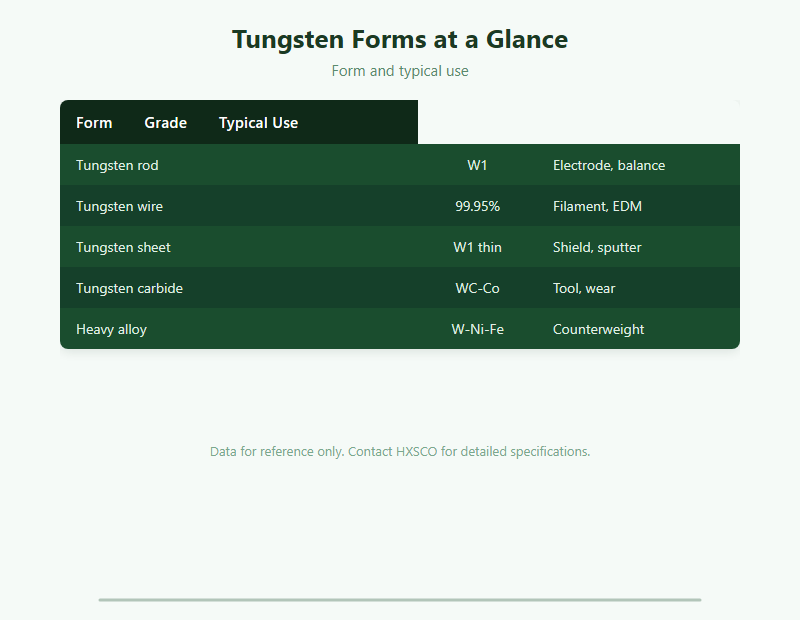
Tungsten Forms
Rod, wire, sheet and carbide cover most needs, with the property basis in our Density Comparison Guide en Hardness Comparison; the alloy basis is in our Alloy Steel Supplier.
Tungsten Carbide Grades
WC-Co grades vary by cobalt content, detailed in our Tungsten Carbide Guide; wear context is in our Corrosion Resistance Guide and strength in our Metal Strength Comparison.
Where Tungsten Is Used
Tools, shielding and counterweights dominate, where our Medical Devices Guide en Aerospace Guide apply; processing is in our Machining Guide.
How to Buy Well
Confirm form, cobalt content and certificate; certification is in our Mill Test Certificate Guide and export packing in our Export Packing Guide; compare on our Refractory Metals Guide.
Get a Quote
Tell HXSCO your requirements and we will respond with a competitive quote and lead time.
Veelgestelde vragen
W1 at about 99.95 percent purity.
Carbide is tungsten plus cobalt, much harder and brittle.
W-Ni-Fe gives high density for compact weights.
Yes – its density makes it excellent radiation shielding.
Request a mill test certificate with chemistry.
Request a Tungsten Quote
HXSCO stocks tungsten rod, wire, sheet, carbide and heavy alloy. Tell us your form, grade and quantity for a fast quote.