


Short answer: Stress corrosion cracking (SCC) is a sudden, brittle failure that needs three things at once — a susceptible alloy, a specific corrosive environment and sustained tensile stress; it is prevented by choosing resistant grades (duplex, nickel alloys, titanium), lowering residual stress through stress-relieving, and controlling the environment rather than by increasing section thickness.
At a Glance
The Three Things SCC Needs
SCC is not a surface-wasting process like general corrosion; it is a crack that propagates with almost no warning when a susceptible microstructure meets a specific chemistry under tension. The classic case is austenitic stainless in warm chlorides, detailed alongside Pitting Corrosion Stainless Steel, but it also occurs in carbon steel under sulfide or carbonate, and in brass under ammonia. The galvanic and electrochemical context is in Galvanic Corrosion Guide, and when the crack follows grain boundaries the alloy choice in Titanium Vs Steel becomes decisive because titanium is essentially immune. Remove any one of the three factors — alloy, environment or stress — and the failure cannot start.
Susceptible Alloys and Environments
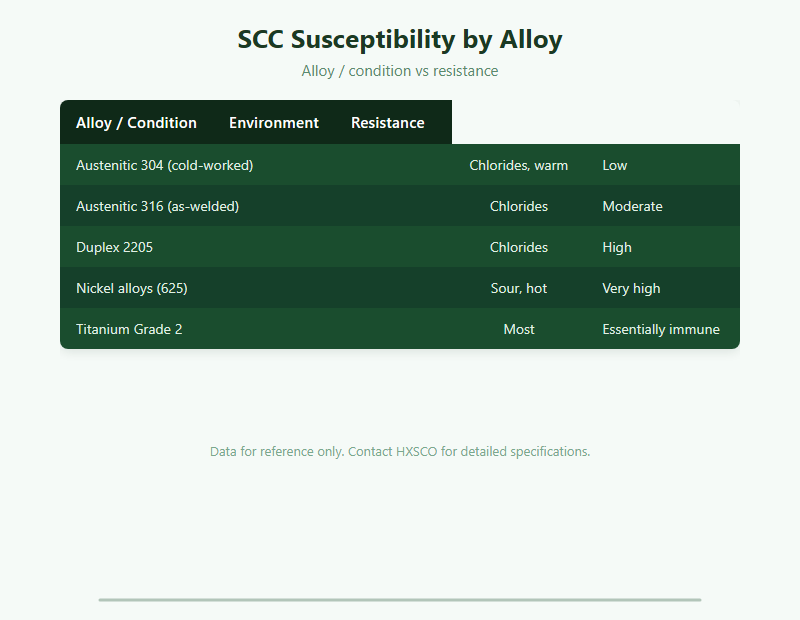
Sensitized or heavily cold-worked 304 is the textbook chloride casualty; 316 improves matters but is still vulnerable in hot concentrated chloride, and Stainless Steel 316 Properties sets out where its limit lies. Duplex Stainless Steel Guide grades such as 2205 resist SCC far better thanks to their two-phase structure, and nickel alloys like 625 shrug off sour, high-temperature environments — the nickel landscape is compared in Inconel Vs Monel. Carbon and low-alloy steels crack under sulfide (stepwise cracking) and caustic, so the duty chemistry must be known before the grade is fixed, not assumed.
Designing It Out
The most reliable fixes are metallurgical and mechanical: specify a resistant grade for the known environment, and eliminate residual tensile stress by Stress Relieving Vs Annealing after welding and forming. Avoid notches and sharp transitions that concentrate stress, control the medium (de-aeration, lower chloride, inhibitor, coating per How To Prevent Metal Rust), and confirm the delivered material actually matches the spec via the certificate in Uitleg over roestvast staal. Thicker section does not help — the crack opens under stress regardless of wall — so resistance must come from alloy and stress control, not mass.
Get a Quote
Tell HXSCO your requirements and we will respond with a competitive quote and lead time.
Veelgestelde vragen
SCC needs three simultaneous factors: a susceptible alloy, a specific corrosive environment (such as chlorides for stainless or sulfides for steel), and sustained tensile stress from load or residual welding/forming stress.
Duplex stainless such as 2205, nickel alloys like Inconel 625, and titanium are highly resistant; austenitic 304 and cold-worked stainless are the most susceptible in chloride environments.
No. SCC propagates under tensile stress regardless of section thickness; resistance must come from a resistant alloy and the removal of residual stress, not from adding material.
Choose an environment-resistant grade, stress-relieve welds and formed parts, avoid stress concentrators, control the corrosive medium, and verify the delivered alloy with mill certification.
Specify SCC-Resistant Alloys from HXSCO
HXSCO supplies duplex, nickel-alloy and titanium grades selected for stress-corrosion resistance, with stress-relieving and mill certification. Send your environment and stress duty for a quote.