


Short answer: Food and beverage equipment relies on stainless steel for hygiene and corrosion resistance. 304 is the standard food grade; 316L is used where salt, acid, or brine are present. Smooth finishes (Ra ≤ 0.8 µm) and hygienic tubing (ASTM A270 / 3A) keep surfaces clean-in-place ready.
At a Glance
Why Stainless for Food Equipment?
Stainless steel is non-porous, easy to clean, and resists the acids, salts, and cleaning chemicals found in food plants. It does not impart taste or odor and survives repeated wash-down and sterilization.
Grade Selection
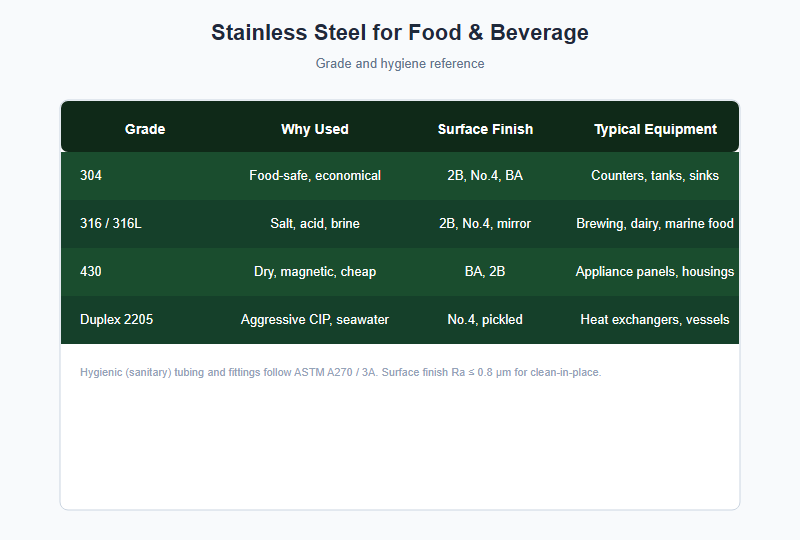
As the chart shows, 304 roestvrij staal handles most counters, tanks, and sinks. 316 / 316L is chosen for brewing, dairy, and marine or salt-exposed food lines because molybdenum resists chloride pitting. 430 is used for dry appliance panels, and duplex 2205 is specified for aggressive CIP and seawater cooling.
Surface Finish and Hygiene
Hygienic surfaces are smooth and non-absorbent. Common finishes are 2B, No.4 (brushed), and BA. For sanitary lines, the inside diameter is often electropolished to Ra ≤ 0.8 µm so bacteria cannot lodge. Welded hygienic tube follows ASTM A270 / 3A standards.
Typical Equipment
- Brewing and dairy tanks, kettles, and silos
- Food prep counters, tables, and sinks
- Conveyor frames and machine guards
- Hygienic piping and CIP return lines
- Oven and dishwasher interiors
Sourcing Food-Grade Stainless from HXSCO
HXSCO supplies food-grade 304 and 316L in sheet, plate, coil, and hygienic tube, with mill-test certificates and the option of electropolishing. Neem contact met ons op with your equipment spec for a quoted package.
Veelgestelde vragen
Yes. 304 is the most common food-grade stainless steel for counters, tanks, and equipment in dry-to-moderate conditions.
Use 316L when equipment meets salt, brine, acidic foods, or aggressive cleaning chemicals, such as in brewing, dairy, and coastal plants.
Smooth finishes like No.4 brushed or electropolished (Ra ≤ 0.8 µm) are easiest to clean-in-place and resist bacterial adhesion.
Tube made to ASTM A270 / 3A with a smooth, often electropolished bore and crevice-free welds, used in dairy, beverage, and pharma lines.
430 is used for dry, non-acidic parts like appliance panels and housings, but 304/316 are preferred for food-contact surfaces.
Ready to source stainless steel?
Tell us the grade, size, quantity, and destination. HXSCO will reply with a competitive quote, lead time, and mill-test options.
Request a QuoteWhy Buyers Trust HXSCO for Stainless Steel
HXSCO is a stainless steel supplier serving manufacturers, fabricators, and trading companies worldwide. We stock 304, 304L, 316, 316L, 430, 201, and duplex grades in plate, sheet, coil, pipe, tube, bar, wire, and rod forms. Every order can be supplied with mill-test certificates, third-party inspection, and custom cutting/shearing to your drawing. Contact HXSCO for a project-specific quote or material recommendation.