



Short answer: Quench cracks are brittle fractures that appear as a steel part cools from the quench — driven by transform stress, sharp geometry and high carbon — and are prevented by good design, controlled cooling and prompt tempering.
At a Glance
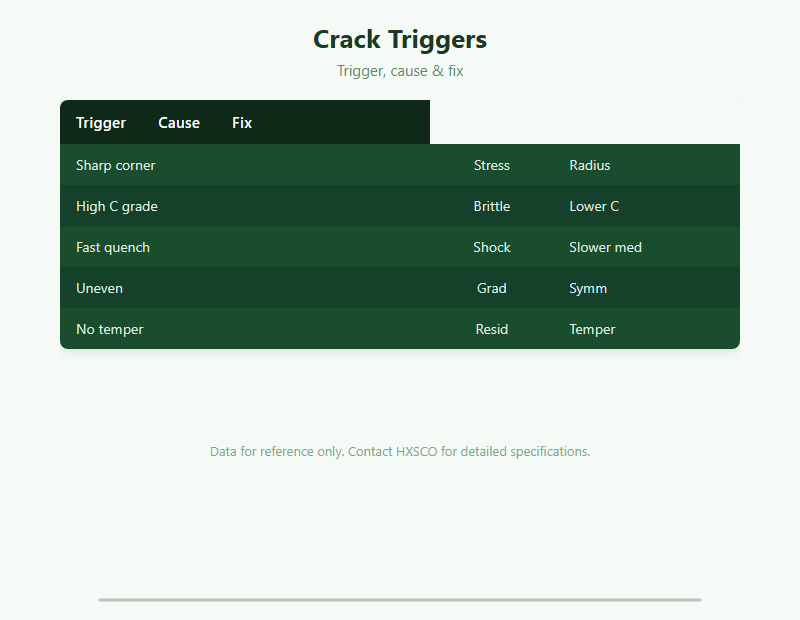
Why Parts Crack
The martensite shell forms first and the core transform later, setting up tensile stress; it is the failure mode of Metal Induction Hardening Guide and relates to Metal Martensite Guide, Stress Relieving Vs Annealing en Metal Creep Guide.
Design Rules
Add radii, keep sections symmetric, choose a lower-carbon grade and temper immediately; review with Metal Tolerances Fits Guide en Metal Machinability Guide.
QA & Supply
Find hidden cracks by Metal Ndt Guide, avoid defects per Weld Defects Guide, and document per Mill Test Certificate Guide. HXSCO supplies grades balanced for hardenability and safety.
Get a Quote
Tell HXSCO your requirements and we will respond with a competitive quote and lead time.
Veelgestelde vragen
Transform stress from uneven martensite formation plus sharp geometry.
Generous radii, symmetric sections, controlled cooling and prompt tempering.
Yes — higher carbon makes the martensite more brittle.
Usually at the quench, but residual stress can open them over time.
HXSCO supplies grades balanced for hardenability without crack risk.
Source Crack-Safe Steel from HXSCO
HXSCO supplies steel grades balanced for safe hardening and low quench-crack risk. Send your grade and quantity for a quote.