


Short answer: Forging shapes metal by compressive force, aligning the grain flow for higher strength and fatigue life but simpler shapes; casting pours molten metal into a mould for near-net-shape complexity at lower cost. The choice follows the load, geometry and volume of the part.
At a Glance
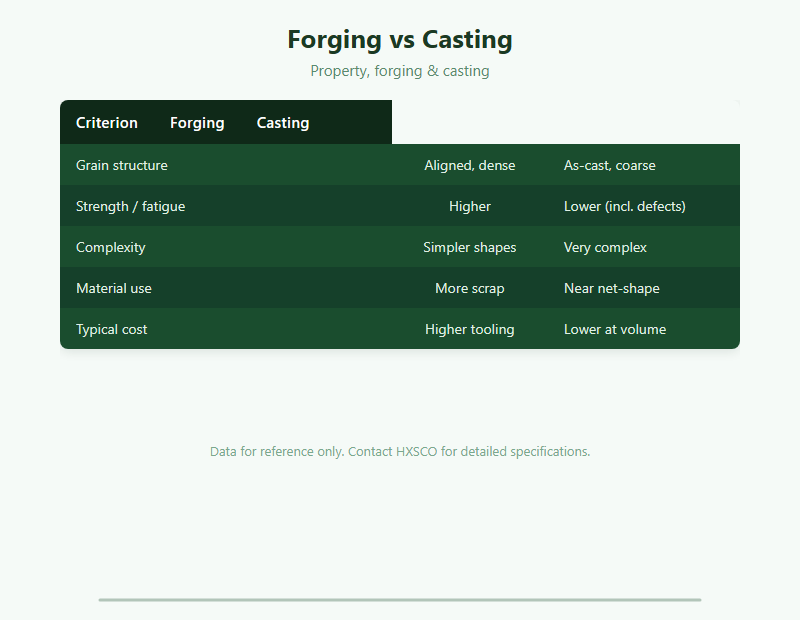
Two Ways to Make a Solid Part
Forging squeezes heated billet between dies (open-die, closed-die, rolled-ring) to refine and align the grain — our Forging Supplier programme. Casting pours liquid metal into a mould to freeze a complex shape — our Casting Supplier programme. Both feed machining (see Metal Stamping Vs Machining) and both ship with a certificate per Mill Test Certificate Guide.
Strength, Quality and Defects
Forging’s aligned, defect-free grain gives superior tensile and fatigue strength and toughness — important for rotating and load-bearing parts (the fatigue basis is in Metal Fatigue Endurance Limit). Casting can harbour shrinkage, porosity and coarse grains that lower effective properties, though soundness improves with process control and NDT. For high-integrity shafts, links and rings, forging wins; for intricate housings and low volumes, casting wins.
Cost and Selection
Forging needs costly dies and more starting material but little finishing; casting saves material and handles complex geometry but may need more machining and inspection. Choose forging for strength-critical, cyclic or safety parts; casting for complex, low-volume or cost-driven shapes. The heat treatment that follows both is in Stress Relieving Vs Annealing, and corrosion planning in Galvanic Corrosion Guide.
Get a Quote
Tell HXSCO your requirements and we will respond with a competitive quote and lead time.
Veelgestelde vragen
Forging compresses solid metal to align the grain for strength and simpler shapes; casting pours molten metal into a mould for complex, near-net shapes at lower cost.
Yes, generally. Forging’s aligned, dense grain gives higher tensile and fatigue strength and fewer internal defects than cast metal of the same alloy.
Casting is usually cheaper for complex, low-volume parts because it needs less material and machining; forging costs more in tooling but less finishing at high volume.
Yes. HXSCO supplies both forged and cast components in carbon, alloy, stainless and aluminum, with mill certificates and inspection.
Forge or Cast with HXSCO
HXSCO supplies forged and cast components in steel, stainless and aluminum, with heat treatment, machining and mill certificates. Send your drawing and volume for a quote.